Challenging a state registrar’s refusal when BTI archives have been lost
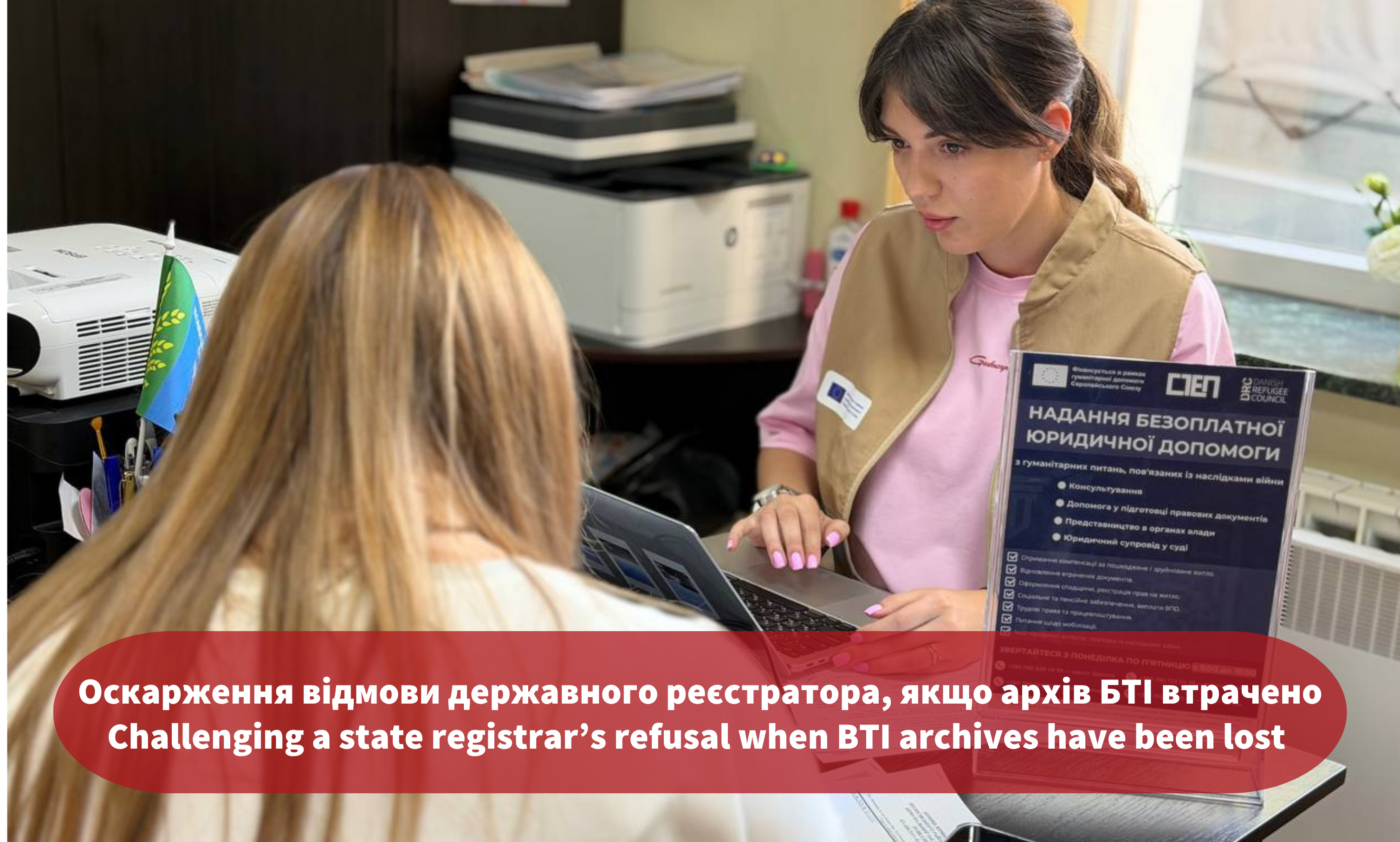
Many people whose homes have been damaged or destroyed as a result of the war face difficulties obtaining the necessary documents and receiving the compensation to which they are entitled. In particular, problems may arise when a state registrar refuses to carry out a registration action or makes a decision with which the property owner disagrees.
In such cases, it is important to know how to challenge a state registrar’s decision and protect your rights. At the same time, the choice of appeal mechanism depends on the circumstances of the individual case and the approaches taken by courts when resolving similar disputes.
Attention! This material is based on judicial practice in Zaporizhzhia Oblast. Courts in other regions of Ukraine may take different approaches. Therefore, when choosing a way to protect your rights, it is advisable to consider the current judicial practice in the relevant region and the circumstances of your particular case.
In most cases, the availability of information about a property in the State Register of Rights to Immovable Property (DRRP) is an important condition for receiving compensation and participating in state support programmes following damage or destruction. However, some property owners face difficulties entering such information into the register due to the absence of archival records from the Bureau of Technical Inventory (BTI) confirming previously registered ownership rights. This most commonly occurs when archives remain in temporarily occupied territories, have been damaged or have become inaccessible due to hostilities.
It is important to remember that the absence of information in the DRRP does not mean that ownership rights have been lost. If ownership was acquired and formalised in accordance with the legislation in force at the time, it remains valid. However, where information is absent from the electronic register, state authorities and digital services may be unable to verify these rights. As a result, property owners may encounter difficulties when applying for compensation for damaged or destroyed housing or carrying out other legally significant actions concerning their property.
Why problems arise with BTI archives
Before 2013, property rights were registered by the BTI, and the relevant information was stored in paper archives. Following the establishment of the State Register of Rights to Immovable Property, information about ownership rights began to be entered into a unified electronic database. If information about a property is absent from the DRRP, the owner may submit documents confirming their ownership rights to a state registrar or notary so that this information can be entered into the register. In certain cases, this can also be done through the Diia portal. More details are available at the link.
The problem arises when, while reviewing an application, the state registrar cannot obtain information from the BTI archives because the archive:
- remains in temporarily occupied territory;
- has been damaged or destroyed as a result of hostilities;
- is effectively inaccessible;
- has not been transferred to another institution;
- does not contain the information required for registration.
In such circumstances, the registrar may refuse state registration. However, the mere absence of BTI archival information is not an automatic ground for refusal.
Is such a refusal lawful
Not always. The Law of Ukraine “On State Registration of Rights to Immovable Property and Their Encumbrances” provides that the mere absence of information in the BTI archives is not an automatic ground for refusing state registration of ownership rights. The registrar must assess all submitted documents and determine whether they are sufficient to confirm the applicant’s ownership rights. If you have documents confirming your ownership rights, but the refusal is based solely on the fact that the BTI archives are inaccessible or that the required information could not be found in them, such a decision may be challenged before an administrative court.
We have previously covered similar cases. You can read more in our articles: Recognition of ownership of real estate through the court due to the lack of data from the Bureau of Technical Inventory (BTI) and The judicial mechanism for establishing ownership in the absence of BTI records.
What should the property owner do
Step 1. Obtain the registrar’s decision refusing registration
Without a written decision, it is impossible to determine the specific grounds for the refusal and which legal remedy would be effective.
Step 2. Establish whether the BTI archives still exist
It is advisable to contact:
- the relevant BTI;
- the local self-government authority;
- the military administration.
If the archives have been lost or are inaccessible, it is necessary to obtain official written confirmation of this fact.
Step 3. Review the documents submitted to the state registrar
If, together with your application for state registration, you submitted original documents specifying the grounds on which ownership rights were acquired and containing a BTI registration endorsement confirming that the rights were registered, these documents may serve as evidence that your ownership rights were duly registered.
It is important to carefully check the information contained in the submitted documents, particularly the BTI registration endorsement, the registration date, the registration entry number and other details concerning the registered ownership rights.
If this information is contained in the documents, but the registrar refused to enter the information into the DRRP solely because the BTI archives were inaccessible, the refusal may be challenged in court.
Step 4. Challenge the refusal in court
Therefore, if the state registrar has nevertheless refused to register your ownership rights, you may apply to an administrative court.
In your statement of claim, identify the authority or institution whose state registrar issued the refusal decision as the defendant. Ask the court to declare the registrar’s decision unlawful and order the registrar to carry out the necessary registration action. There are several ways to submit a court challenge against a state registrar’s refusal.
- In person through the court registry office:
The claimant may personally visit the registry office of the relevant administrative court and submit the statement of claim together with its supporting documents. In this case, it is advisable to prepare an additional copy of the statement of claim on which a court employee can place a stamp confirming receipt.
- By post:
The statement of claim may be sent to the court by post. In practice, it is advisable to use registered mail with an inventory of enclosures and acknowledgement of receipt. This makes it possible to confirm exactly which documents were sent to the court and when the court received them. It is advisable to keep the inventory of enclosures together with the postal receipt and delivery confirmation.
- Through the electronic cabinet of the UJITS:
For many applicants, the most convenient option is to submit a claim electronically through the Unified Judicial Information and Telecommunication System.
What must be proven in court
1. Ownership rights arose before 1 January 2013.
For example, an apartment was acquired under a sale and purchase agreement, an exchange agreement or another agreement.
2. Ownership rights were formalised or registered in accordance with the legislation in force at that time.
It is important to confirm not only that you acquired ownership of the apartment, but also that these rights were properly formalised and registered under the rules applicable at that time. Evidence may include, in particular, a BTI registration endorsement on the title document, a certificate of ownership or other documents bearing a registration endorsement.
3. You submitted the documents to the state registrar.
4. The documents made it possible to identify the property owner, the immovable property and the fact that ownership rights to that property had been registered.
5. The registrar refused registration, citing the absence of information from the BTI.
6. The absence of BTI information was not your fault but resulted from the objective inaccessibility of the archives.
7. The registrar failed to explain why the submitted documents were insufficient to carry out registration.
A document confirming payment of the court fee must be attached to the statement of claim unless there are legal grounds for exemption from payment. The amount of the court fee depends on the type of claim and the claimant’s status. Therefore, before submitting the claim, it is necessary to check the applicable court fee rate as of the date of filing. If the claimant is entitled to an exemption from the court fee, this must also be confirmed by the relevant supporting documents.
Therefore, it is important to understand that if a state registrar has refused to enter information about ownership rights into the DRRP, this refusal may be challenged, including through court proceedings. However, before applying to court, it is important to assess the documents confirming ownership rights, the reasons for the refusal and the circumstances surrounding the absence or inaccessibility of the BTI archives.
To ensure a proper assessment of your situation and determine the most appropriate way to protect your rights, it is advisable to seek legal assistance and obtain a free consultation through the PravoVsim platform at the link.
This information material was developed within a project implemented by the NGO "STEP" in cooperation with the Danish Refugee Council (DRC) with funding from the European Union. However, the views and opinions expressed are those of the author alone and do not necessarily reflect the views of the European Union or DRC.