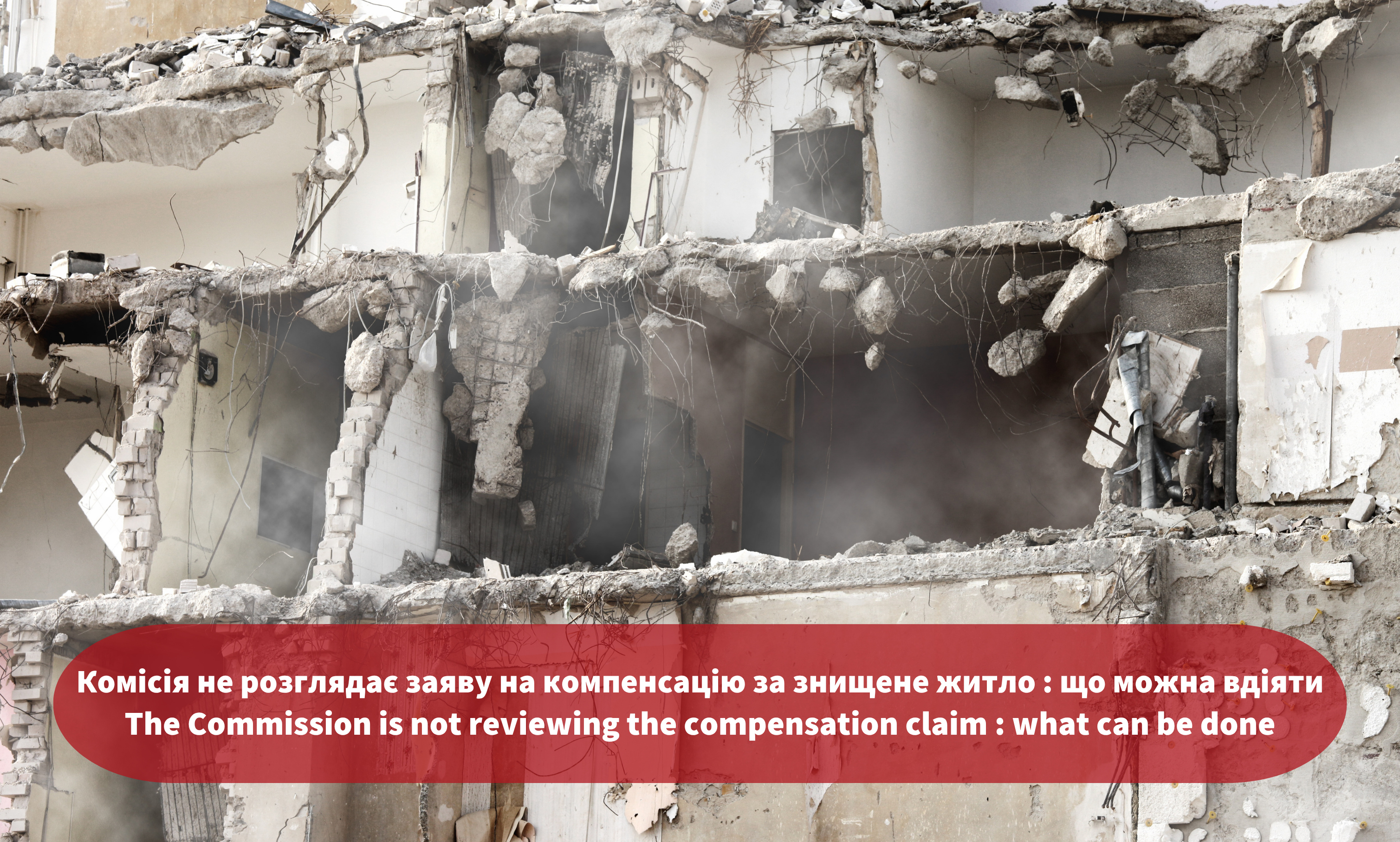
The Commission is not reviewing the claim for compensation for the destroyed home: what can be done
The eVidnovlennia (eRecovery) programme and state compensation for destroyed or damaged housing have given many Ukrainians an opportunity to recover housing lost after 24 February 2022. In practice, however, applicants often face situations where weeks or even months pass after submitting an application, while its status in the Diia app remains unchanged. What can you do if the commission does not review your application for a long time? What time limits are established by law, and what steps can an applicant take to protect their rights? Let us consider this step by step.
Important: this article is not about submitting an information notice regarding damaged or destroyed housing, but specifically about an application for compensation — in the form of a housing certificate for destroyed housing or monetary compensation for rebuilding a destroyed home.
If you are interested in the full compensation procedure, we recommend reading our article: "How to receive compensation for destroyed housing in areas of possible and active hostilities: Step-by-Step Guide".
How much time does the commission have to review an application
Under the main legislation establishing the compensation mechanism - Law of Ukraine No. 2923-IX and the Procedure for Providing Compensation for Destroyed Immovable Property, approved by Resolution of the Cabinet of Ministers of Ukraine No. 600 - the commission must review an application for compensation within 30 calendar days from the date of submission.
In certain cases, this period may be extended by a further 30 calendar days. For example, where additional documents are required, an additional verification needs to be carried out, or the security situation makes it impossible to inspect the destroyed housing.
If the commission extends the period for reviewing the application, it must inform the applicant and explain the reason. In practice, such notification is most often sent through the Diia app or portal, by email, or by post.
If 30 days have passed, or 60 days where the review period has been extended, and you have received neither a decision nor notification of an extension, it is advisable to submit a written request to the local self-government body under which the commission was established, asking about the status of the application. If the application is being left without consideration without lawful grounds, such inaction may be challenged, including by filing a claim with an administrative court.
Important: The fact that no decision has been made within 30 days does not always mean that there has been a violation. First, it is advisable to clarify whether the review period has been formally extended and whether there are lawful grounds for doing so. In such a situation, we recommend preparing the necessary information and moving to active steps.
Why can delays occur
A delay in reviewing an application is not always the result of unlawful inaction by the commission. In many cases, it may be caused by the following objective or technical reasons:
- Problems with documents. Discrepancies between data in the Register of Damaged and Destroyed Property (RDDP) and the State Register of Rights to Immovable Property.
- High workload of the commission. In regions with extensive destruction, commissions may simply be unable to process the large number of applications promptly due to staff shortages.
- Security situation. If the hromada is located in an area of active hostilities or is subject to constant shelling, an on-site visit by the commission to inspect the property may be postponed for security reasons.
- Remote assessment. If an on-site inspection cannot be conducted for security reasons, the commission may carry out a remote assessment in cases provided for by law. In practice, such applications may also take longer to review because additional materials may be needed, technical issues may arise during the remote assessment, or the commission may not yet have adopted a decision to conduct it. If no decision on a remote assessment or resumption of the application review is made for a prolonged period, it may be appropriate to submit a written application to the commission requesting that the review be resumed and a remote assessment be conducted, where there are grounds to do so.
Step-by-step guidance: how to facilitate the review of your application
If all statutory time limits have expired, proceed consistently as follows:
Step 1. Check the status and registers
First, check the status of your application in the Diia app or portal. The status may contain information on the progress of the review, including whether the application is being processed, whether the review has been suspended, or other information that may help determine the reason for the delay.
In addition, obtain an extract from the Register of Damaged and Destroyed Property (RDDP). This can be done through the Diia app. The extract contains information about the registered information notice, the compensation application, their details and current status. This document will help you verify that the information is up to date and may be useful when contacting the commission, the local self-government body or the court.
Step 2. Submit a written request to the local self-government body
Commissions that review compensation applications are established under the local self-government bodies of the relevant territorial hromadas and operate within their structure. Therefore, in the event of delay or inaction, it is advisable to submit a written request specifically to the local self-government body, asking it to ensure that your application is reviewed or to provide information on the reasons for the delay.
Verbal requests to the commission secretary or telephone calls to the hromada hotline do not always make it possible to confirm that you contacted the authority or what exactly you requested. We therefore recommend submitting an official written request addressed to the head of the body under which the compensation commission was established.
What should be included in the request
In addition to the applicant's personal details and details of the local self-government body, it is recommended to indicate:
- the date on which the compensation application and/or information notice was submitted through the Diia app;
- the registration number of the application, if available;
- the address of the damaged or destroyed immovable property;
- a request to provide information on the status of the application, the reasons for the delay, if any, and the approximate timeframe for a decision.
How to submit the request:
- in person through the administrative office of the local self-government body. Be sure to keep a second copy on which the secretary or another responsible official records the registration details, including the incoming number, date and, where possible, the signature of the responsible official;
- by registered post with an inventory of enclosures and delivery confirmation through JSC Ukrposhta;
- to the official email address of the local self-government body. In this case, it is recommended to sign the request with a Qualified Electronic Signature (QES) or attach scanned copies of the signed request and documents. If copies of documents are submitted, it is advisable to certify them personally by writing "True copy of the original", indicating the date, surname and initials, and adding a signature. Using a QES reduces the risk that the request may be left without consideration. You can read how to create an electronic signature in our material.
Having a written request and proof that it was submitted may become important evidence if you later challenge the commission's inaction or apply to court.
Timeframe for consideration of the request
Written requests from citizens must be considered within no more than one month from the date they are received. If a request does not require additional examination, it must be considered without delay, but no later than within 15 days. If the matter cannot be resolved within one month, the head of the relevant authority or their deputy may establish another timeframe for consideration, and the applicant must be informed in writing. The overall period for considering the request may not exceed 45 days.
Step 3. Complaints to the relevant ministries
If the local authorities ignore the request or provide only a formal response, you may contact higher-level authorities:
- In the event of inaction by the commission or failure to respond to your request, you may contact the Ministry for Development of Communities and Territories of Ukraine, which is responsible for the development and implementation of state policy on compensation for damaged and destroyed property. You may also contact the Ministry's hotline at (044) 351-48-01 every Tuesday from 14:00 to 16:00.
- Ministry of Digital Transformation of Ukraine — if there are grounds to believe that the delay is related to a technical issue in the Diia app or portal, for example, the application is not displayed, its status is displayed incorrectly, or technical errors occur. In such cases, it is recommended to submit a request through the online form for citizens' requests or contact Diia support. You may also call (044) 207-17-48 or send a request to zapyt@thedigital.gov.ua.
- Call the Government Hotline at 1545. Such requests are registered and considered in accordance with the Law of Ukraine "On Citizens' Appeals", and the applicant receives a response within the statutory timeframe.
Step 4. Submit an application to resume the review
If the commission suspended the review because it was impossible to inspect the destroyed housing, for example due to active hostilities, a threat to the life or health of commission members, or lack of access to the property, once those circumstances cease to exist or new materials become available, you may apply to the commission requesting that the review be resumed.
What may constitute grounds for resuming the review
Grounds may include new circumstances, documents or other materials that make it possible to continue reviewing the application and establish the fact that the housing was destroyed, including:
- new photographs, video materials, satellite images or other materials confirming the destruction of the housing;
- an additional technical report, technical conclusion or another document prepared by a specialist regarding the condition, nature and extent of destruction of the property;
- inspection reports, certificates or other materials from local self-government bodies;
- documents or information demonstrating that an assessment can now be conducted, including remotely;
- other circumstances or materials that make it possible to continue reviewing the application.
What should be attached to the application
It is advisable to attach documents or other materials confirming the grounds for resuming the review, including:
- a copy of the commission's decision to suspend the review, if available;
- an additional technical report, technical conclusion or another document concerning the condition and nature of destruction of the property;
- photographs and video materials of the destroyed housing;
- inspection reports, certificates, conclusions of specialists or experts;
- documents or information confirming that an assessment, including a remote assessment, can be conducted or that access to the property has been restored;
- documents and information from local self-government bodies.
What should be stated in the application
It is recommended to indicate:
- details of the previously submitted compensation application;
- the date and details of the decision to suspend the review, if available;
- what new circumstances or materials have emerged since the review was suspended;
- why those circumstances or materials make it possible to continue reviewing the application;
- a list of the attached documents and other materials;
- a request to resume consideration of the application and take the additional materials into account;
- up-to-date contact details.
Step 5. Seek legal assistance
If requests and complaints do not produce a result, you may challenge the commission's decision, actions or inaction in court.
Please note: the time limit for applying to court is six months from the date when you became aware or should have become aware of the violation of your rights. Therefore, do not delay seeking legal assistance.
We recommend contacting a lawyer who can assess the situation, determine the appropriate legal remedy and claims, and prepare the documents required for court proceedings.
If you need legal support in obtaining compensation for destroyed housing, you can seek a free legal consultation via this link.
This information material was developed within a project implemented by the NGO "STEP" in cooperation with the Danish Refugee Council (DRC) with funding from the European Union. However, the views and opinions expressed are those of the author alone and do not necessarily reflect the views of the European Union or DRC.