How to receive compensation for destroyed housing in areas of possible and active hostilities: Step-by-Step Guide
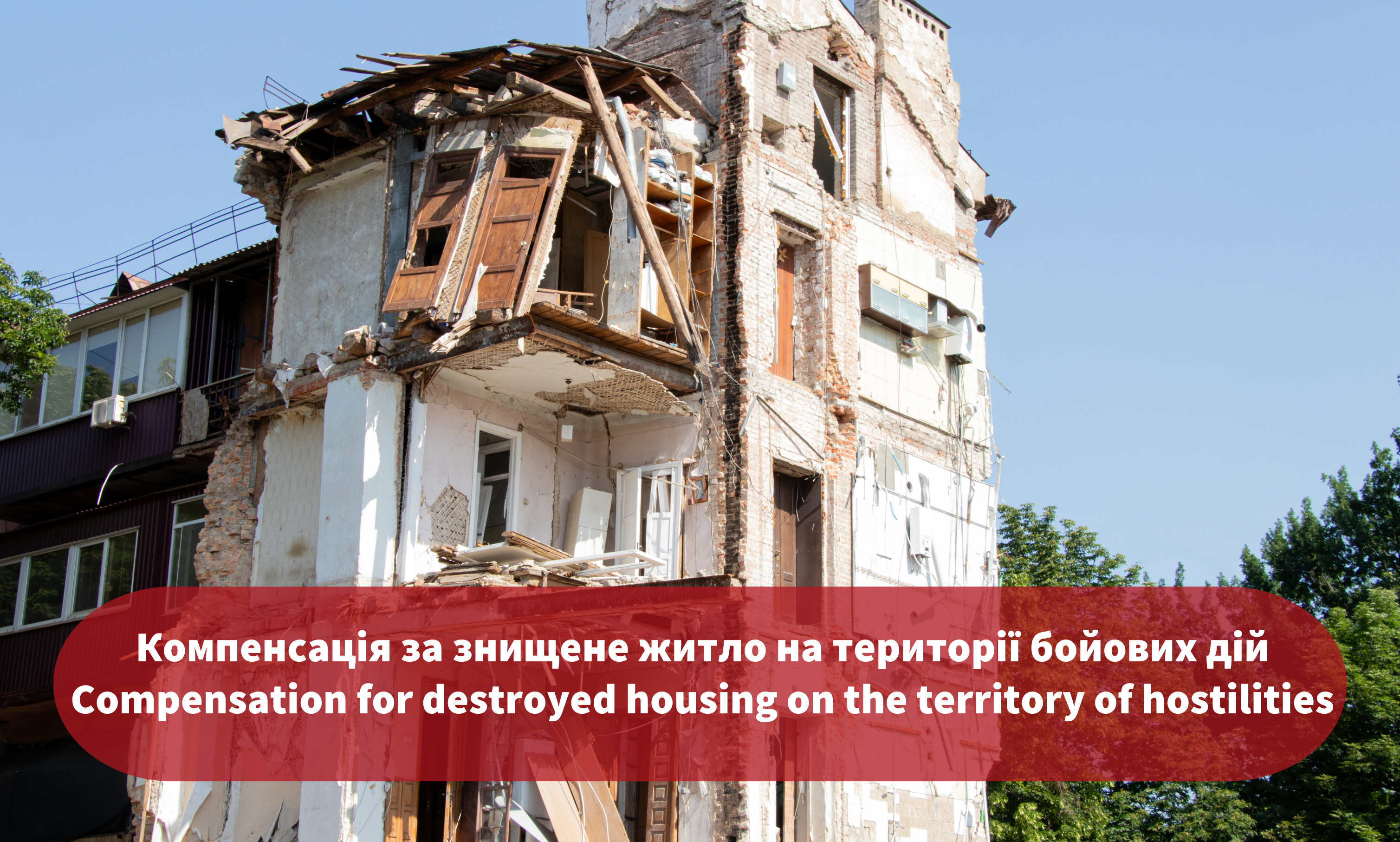
If your housing has been destroyed and is located in an area of active or potential hostilities, where an on-site inspection by a commission is not possible due to the security situation, you are still entitled to compensation. The Government has introduced a special remote assessment mechanism, which makes it possible to confirm destruction using modern technologies.
Where to start?
Step 1. Collect information about the condition of your housing
Before initiating the compensation procedure, it is important to clearly distinguish between two key concepts that determine the type of assistance available, and to understand: is your housing damaged or destroyed?
Damaged property is housing that can be restored through current or major repairs, reconstruction, or restoration.
The key feature of damaged housing is that the property remains an integral object and can be returned to a condition suitable for habitation.
Example of damaged housing:

Destroyed property is housing that has completely lost its functionality or cannot be restored due to critical damage to load-bearing and enclosing structures. The key feature of destroyed housing is that it is unfit for use for its intended purpose.
Example of destroyed housing:

We recommend preparing in advance any documents, photos, or videos of your housing prior to its damage or destruction. The availability of such materials may help the commission more quickly identify the object in satellite imagery and compare its condition before and after the damage (destruction).
How to obtain up-to-date information about the condition of housing?
An important source of evidence may include testimonies of neighbours or eyewitnesses who directly observed the moment of impact or the scale of the fire resulting from shelling. Such information can be collected via phone communication or messaging applications. It is also advisable to regularly monitor information published online. Local Telegram channels, Viber groups, or Facebook communities often share real-time footage of the aftermath of shelling. If you find photos or videos of your housing in media or social networks, be sure to save them, as these materials may be used as supporting evidence in your application.
In addition, it is appropriate to refer to official reports of the State Emergency Service of Ukraine (SES) or the National Police, which may contain recorded information about damage and destruction in your locality.
Based on the collected information, it is advisable to establish the approximate date and time of the incident that caused the damage or destruction.
Step 2. Check for eligibility and possible restrictions
To receive compensation for damaged or destroyed housing under the state compensation programme “eVidnovlennia”, different requirements apply, but they share the following:
- the applicant-owner must be a citizen of Ukraine;
- information on the applicant-owner’s ownership rights to the damaged/destroyed housing must be available in the State Register of Real Property Rights (DRRP).
Who is not eligible for compensation?
Certain categories of persons are excluded from receiving compensation:
- individuals subject to state sanctions under the Law of Ukraine “On Sanctions”;
- individuals convicted of crimes against the foundations of national security of Ukraine;
- heirs of such persons.
Q&A
1. If I am not a citizen of Ukraine but own damaged/destroyed housing registered in the State Register, can I receive compensation under the eVidnovlennia programme?
Unfortunately, no. The legislation limits eligibility to individuals who are citizens of Ukraine.
At the same time, such persons may submit a claim to the International Register of Damage for Ukraine under category A3.1 “Damage or destruction of residential property”.
2. Why can only the owner receive compensation?
Under the law, only the owner has the right to possess, use, and dispose of their property. Since receiving state compensation is considered a form of disposal, this right belongs exclusively to the legal owner.
Even if you hold original paper documents, your ownership must be registered in the State Register of Real Property Rights (DRRP).In practice, issues with missing records often arise for persons who registered their property with the Bureau of Technical Inventory (BTI) in paper form before 2013.An extract from the State Register is currently the most reliable way to confirm that your ownership is officially recognised by the state.
3. Is a housing warrant proof of ownership?
No. A housing warrant is not a document confirming ownership.
It is an administrative act granting the right to occupy a residential premises (usually state or municipal housing). Ownership remains with the state, territorial community, or enterprise.
The only way to obtain ownership of such housing is through privatisation.
For more details on housing privatization, please see our other informational article – Privatisation of housing during martial law in Ukraine.
4.What should I do if I have original ownership documents, but my ownership is not registered in the State Register?
Currently, there are various documents that may serve as a basis for entering ownership information into the State Register, including:
- ownership certificates;
- contracts (sale-purchase, exchange, gift, lifetime maintenance, etc.);
- certificates of inheritance;
- court decisions that have entered into legal force.
You need to apply to a Centre for Administrative Services (CNAP), a state registrar, or a notary to register your ownership rights.
This can be done in two ways:
- independently in electronic form;
More details are available in our article How to register real estate via Diia portal.
- by applying to a competent authority.
Check whether you have original technical documentation and ownership documents issued before 2013 (for example, an inheritance certificate, technical passport, sale-purchase agreement, etc.). With these documents, apply to a CNAP, state registrar, or notary to receive the administrative service.
5. What should I do if I do not have documents confirming my ownership?
In case of loss, damage, or destruction of original documents, you may still be eligible for compensation. The procedure depends on the date of issuance and the possibility of obtaining duplicates.
A detailed step-by-step guide is available in the article If housing documents are lost. When should you worry and what can be done.
6. Can compensation be received if the owner has died?
Yes, compensation is possible, but heirs must first apply to a notary to initiate inheritance proceedings.
After formalising inheritance rights to the damaged/destroyed housing, the heir receives a certificate of inheritance and an extract from the State Register, which provides access to compensation.
Step 3. Determine whether the locality is classified as an area of possible or active hostilities
The only official source of such information is the Order of the Ministry for Communities and Territories Development of Ukraine No. 376 dated 28 February 2025 (as amended).
Information available online, in the media, or on platforms such as DeepState does not always correspond to the data contained in the above-mentioned Order. Currently, in areas of possible hostilities (for which no end date has been defined) and in areas of active hostilities, the state compensation programme “eVidnovlennia” provides compensation only for destroyed (demolished) housing. If your housing located in an area of active hostilities is damaged, meaning it can be repaired, compensation under the eVidnovlennia programme is not provided.
Step 4. Submit an information notice and application for compensation
You may choose the most convenient option for submitting an information notice, regardless of your current location:
- Independently via the Diia mobile application: available for individuals who have a taxpayer identification number (RNOKPP).
To do this, download the Diia mobile application to your phone → log in to the application → select the “Services” tab → go to the “eVidnovlennia” section → select “Report damaged property” and answer the required questions.
- Independently via the Diia web portal (in a browser): suitable for individuals who, due to religious beliefs, have refused to obtain a taxpayer identification number and have a corresponding mark in their passport.
To submit an information notice via the Diia web portal, you need to create a qualified electronic signature (QES) and use it to log in to the portal. After that, select the “Services Catalogue” tab → “Report damaged property” and answer the required questions.
We recommend reviewing our information article How to create an digital signature?
- Through a Centre for Administrative Services (CNAP) administrator: in this case, the administrator completes the information notice in your presence and, upon your request, provides you with a printed copy.
What information must be provided in the information notice?
In the notice, you should provide personal information (full name, contact phone number, email address) and details about the destroyed property:
- type of real estate and its area;
- address or geospatial coordinates;
- condition of the property (“unfit for use” or “fully destroyed”);
- description of damage (for example, significant damage to load-bearing and enclosing structures, the extent and nature of which indicate a risk of structural collapse);
- number of persons who resided in the housing;
- date and approximate time of the incident; where available, you should also attach photos confirming the destruction of the housing.
Please note that you bear full responsibility for the accuracy of the information provided.
After submission, the information notice is entered into the Register of Damaged and Destroyed Property (RDDP).
Step 5. Submission of the compensation application
After submitting the information notice, submit an application for compensation. In the application, you must indicate which type of compensation you choose. This may be:
- a housing certificate — a document that allows you to purchase new housing instead of the destroyed one; or
- a monetary payment for reconstruction on your own land plot.
Please note that the second option is available only to owners of private houses who have a land plot located in a safe area. Such an application can currently be submitted via the Diia mobile application.
The compensation application is submitted in the same way as the information notice:
- via the Diia mobile application (Services → eVidnovlennia → Applications for payment);
- via the Diia web portal in the section “Compensation for damaged or destroyed property” (in a browser);
- through any Centre for Administrative Services (CNAP) at the place of application.
Step 6. Assessment of destroyed housing
After submitting the information notice and the compensation application, the work of a specialised assessment commission begins. This commission is established by local self-government bodies or regional military administrations.
How and within what timeframes is the assessment conducted?
Within 10 calendar days after your information notice is registered in the Register of Damaged and Destroyed Property (RDDP), the authorised body must inform you how the assessment of the destroyed housing will be carried out:
- Commission-based assessment (on-site visit of the commission to the location of the property to conduct a visual inspection). This type of assessment is conducted provided that there is no direct threat to the life or health of commission members related to hostilities.
- Technical assessment (visual inspection by a certified expert who analyses the technical condition of load-bearing structures and the possibility of their restoration). This type of assessment is conducted if, based on the commission-based inspection, it is not possible to determine the extent of damage or confirm the fact of destruction.
- Remote assessment (the commission establishes the fact of destruction without a physical visit, based on remote sensing data). This type of assessment is conducted where there is a threat to life and health during the inspection due to military (combat) actions, and it is this type of assessment that is the focus of this information article.
The notification will be sent to the email address or phone number indicated in the information notice.
The total duration of the remote assessment must not exceed 30 calendar days from the date of submission of the notice.
What can the commission do?
To confirm the fact of destruction of housing, the commission may обратиться до таких органів:
- the State Service of Ukraine for Geodesy, Cartography and Cadastre (StateGeoCadastre), the Ministry of Defence of Ukraine, and the State Space Agency of Ukraine — to obtain high-resolution satellite imagery;
- the State Emergency Service of Ukraine (SES) and the National Police of Ukraine — to obtain documents and information confirming the fact of destruction (for example, fire reports, shelling reports, etc.);
- the command of military formations of the Armed Forces of Ukraine — to obtain additional information that may contribute to an objective assessment of the condition of the property;
- other competent public authorities — where clarification of the technical characteristics of the property or the circumstances of its destruction is required.
If requests are submitted, the above-mentioned authorities are obliged to provide a response within 15 calendar days.
To make a decision on whether a real estate object is destroyed, the commission analyses:
the characteristics of the housing prior to its destruction;
documents and materials submitted together with the information notice and received from competent authorities;
written or oral testimonies of persons aware of the circumstances of the incident (if available);
analytical data, including data generated using artificial intelligence.
What should you do if the commission suspends the review of the information notice?
If, based on the available imagery, it is not possible to conclusively establish the fact of destruction of the housing, the commission adopts a decision to suspend the assessment and must notify the applicant within 5 working days.
Option 1: You have additional evidence
After receiving the decision on suspension, you have 90 days to provide the commission with additional information:
- new photographs or video materials;
- written statements from neighbours or eyewitnesses to the incident;
- other evidence confirming damage (destruction) of the housing.
As soon as you submit this information, the review of the notice must be resumed, and you must be informed about this within 5 calendar days.
Option 2: You do not have any additional information or evidence
If the applicant does not have any additional information (evidence) confirming the destruction of the housing, it is necessary to wait for the status of the notice to be updated.
The commissions regularly receive new data from UAVs or satellites. As soon as clear imagery confirming the destruction of the housing becomes available, the review of the notice must be resumed, and the applicant must be notified within 5 calendar days.
Documentation of assessment results
Based on the results of its work, the commission prepares a remote assessment report within 5 working days. If the fact of destruction is confirmed, the property is officially recognised as destroyed. Within 3 working days after the report is prepared, it is registered in the Register of Damaged and Destroyed Property (RDDP). A copy of the report must be sent to the applicant via the Diia portal or to their email address within 3 working days from the date of its registration.
What happens next?
Based on the remote assessment report, the compensation commission adopts one of the following decisions:
- to grant compensation;
- to refuse compensation.
Notification of the adopted decision will be sent no later than the next day:
- in electronic form: via the Diia portal or mobile application;
- in paper form: to the postal address indicated in the application.
What should you do after the decision is adopted?
Option 1: If your application is approved
You receive compensation in the form of a housing certificate.
- the certificate is valid for 5 years from the date of issuance;
- you may use it to purchase housing on the primary or secondary market in any region of Ukraine or as a down payment under the eOselya mortgage programme.
Option 2: Refusal of compensation
If you receive a refusal, this is not always a final outcome. In this case, we recommend:
- verifying the legality and justification of the commission’s decision (for example, due to errors in registers or insufficient evidence);
- submitting an objection to the authorised body or applying to court if the actions of the commission are unlawful.
If you need advice or assistance regarding compensation for damaged or destroyed housing, you can book an online legal consultation with a lawyer via the link.
This material was created by the NGO “STEP” in partnership with the Danish Refugee Council with funding from the European Union. The views and opinions expressed are those of the author(s) alone and do not necessarily reflect the views of the European Union or the DRC. Neither the European Commission nor the DRC can be held responsible for the content of this material.