How the “Houses in the Village” program for IDPs will work in hromadas
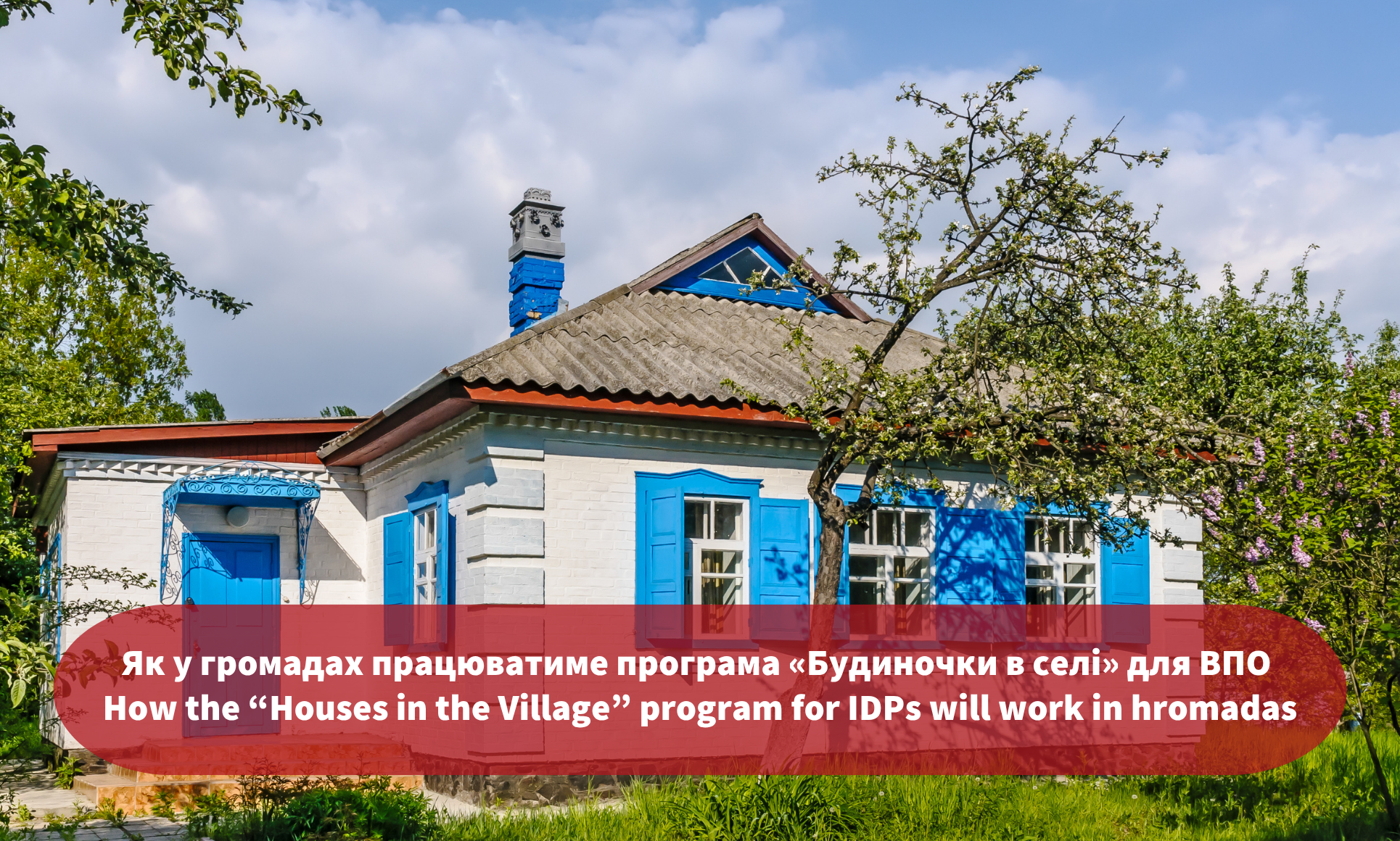
For many internally displaced people, the housing issue has long ceased to be temporary. Years of living in dormitories, collective accommodation centres, or rented housing have become a reality for thousands of families. At the same time, mortgage programmes often remain inaccessible to people without stable incomes, elderly people, large families, and people with disabilities.
On 10 June 2026, the Cabinet of Ministers of Ukraine adopted Resolution No. 751, launching a two-year pilot initiative known as the "Houses in the Village" Programme. Under this programme, Ukrainian hromadas will be able to provide housing for internally displaced people by purchasing vacant residential houses in rural areas. The programme is designed to address two challenges simultaneously: helping people who have lost their homes because of the war while supporting rural hromadas that have vacant housing and are interested in attracting new residents.
Free housing does not mean ownership of the house
It is important to understand from the outset:
- The programme does not provide ownership of a house to an internally displaced person. Once purchased, the property becomes part of the communal property of the territorial hromada. IDPs will instead sign a free-of-charge housing use agreement for a period of up to three years. The agreement may subsequently be extended.
- Although no rent will be charged, residents must independently pay for consumed utility services and comply with the terms and conditions of the housing use agreement.
Who can receive housing
The programme is intended for internally displaced people who do not have habitable housing in a safe area of Ukraine or who lost their homes as a result of the war.
Who is not eligible
Applications cannot be submitted by people who have already received, or are entitled to receive, compensation for destroyed housing or a housing voucher.
The programme also does not apply to persons who, during the previous six months, purchased:
- a land plot worth more than UAH 100,000; or
- a vehicle less than five years old.
Who will receive priority
Priority will be given to vulnerable categories of internally displaced people, including:
- large families;
- people with disabilities;
- families raising children with disabilities;
- orphans and children deprived of parental care;
- adults who previously held either of these statuses;
- elderly people.
However, priority status does not guarantee that a house will automatically be provided. Allocation will depend on the capacity of the hromada, the availability of suitable housing, and the funding available for its purchase.
What requirements must a house meet
Not every vacant house can be purchased under the programme.
The house must:
- be suitable for occupancy without requiring major repairs or reconstruction;
- have electricity and heating;
- not create a disproportionate maintenance burden for the hromada;
- have its ownership duly registered in the State Register of Rights to Immovable Property;
- not be subject to arrest or any other encumbrance;
- have no outstanding utility debts.
An IDP family may independently identify a house whose owner is willing to sell it and propose the property to the hromada for consideration. Councils of internally displaced persons, civil society organisations, charitable organisations, volunteers, and public institutions may also assist in identifying suitable housing. However, the final decision on inspecting and purchasing a house rests with the relevant local self-government body or military administration.
How to apply
The procedure does not begin with placing an IDP on a waiting list. Instead, it starts with identifying a specific residential house and obtaining the owner's preliminary consent to sell it.
After that, the process is as follows:
Step 1. Find a house
The hromada, together with the IDP family interested in obtaining housing, identifies a suitable residential property. Once a suitable house has been found, the owner is approached to obtain preliminary agreement on both the sale and the proposed purchase price.
Step 2. Submit an application
Within three calendar days after reaching such preliminary agreement, the IDP submits an application for the provision of housing for free use.
The application may be submitted:
- in person;
- by post; or
- electronically through the Pension Fund of Ukraine web portal, using a qualified electronic signature.
The application must include:
- information about the applicant and household members;
- details of identity documents;
- the Taxpayer Registration Number (RNOKPP);
- details of the applicant's IDP certificate.
The following documents must be attached:
- documents confirming family relationships;
- evidence confirming that the applicant's previous home was destroyed or has become uninhabitable.
Step 3. Housing inspection
The local self-government body or military administration establishes a temporary commission to inspect the proposed property. Following the inspection, the commission prepares an inspection report confirming the technical condition of the house and whether it complies with the programme requirements.
Step 4. Purchase of the house by the hromada
If the inspection report is positive, the hromada finalises the purchase price with the owner, adopts a decision to purchase the property, and registers it as communal property. The State may provide a subvention of up to UAH 500,000 for the purchase of one residential property. This amount includes taxes, mandatory fees, and state registration costs. If the purchase price exceeds this amount, the difference may be covered through the local budget, donor funding, or other lawful co-financing sources.
Step 5. Signing the agreement
No later than five calendar days after the house has been registered as communal property, the internally displaced person (IDP) signs a free-of-charge housing use agreement with the hromada.
An integral part of the agreement is the handover and acceptance certificate, which records:
- the condition of the house;
- any existing defects;
- utility meter readings;
- furniture;
- equipment; and
- any other property transferred together with the house.
Step 6. Registration and moving in
The IDP must register their place of residence at the provided house within 30 calendar days from the date the agreement is signed. The family has up to 60 calendar days to move into the house.
What obligations must the family fulfil
Although the housing is provided free of charge, programme participants must comply with several obligations:
- maintain the house in good condition;
- pay for utility services;
- not lease or sublease the house;
- promptly notify the hromada of any changes in their property status or household composition;
- ensure that any able-bodied household member who is unemployed takes steps to obtain employment or registers as unemployed within three months of moving into the house.
When the right to use the housing may be terminated
The housing use agreement may be terminated before its expiry if:
- the family is provided with other housing;
- the applicant or household members no longer meet the programme eligibility criteria;
- changes in the family's property status or household composition are not reported within 14 calendar days;
- an able-bodied unemployed household member fails to seek employment or obtain unemployed status;
- utility payment arrears remain outstanding for more than 90 calendar days;
- the house is leased or subleased;
- persons who are not members of the household reside in the house;
- the occupants damage the house or other property, or repeatedly violate the rules governing the use of the property or public order.
Before signing the agreement, carefully review its terms and examine the handover and acceptance certificate. This will help avoid situations in which the family may later become liable for damage or defects that already existed before they moved into the house.
At the same time, it is important to remember that the "Houses in the Village" Programme is currently being implemented as a pilot project. The coming years will demonstrate whether it becomes a permanent element of Ukraine's housing policy or remains a solution available only to a limited number of hromadas and internally displaced families.