What happens to a claim submitted to the Register of Damage if the claimant dies
Published:
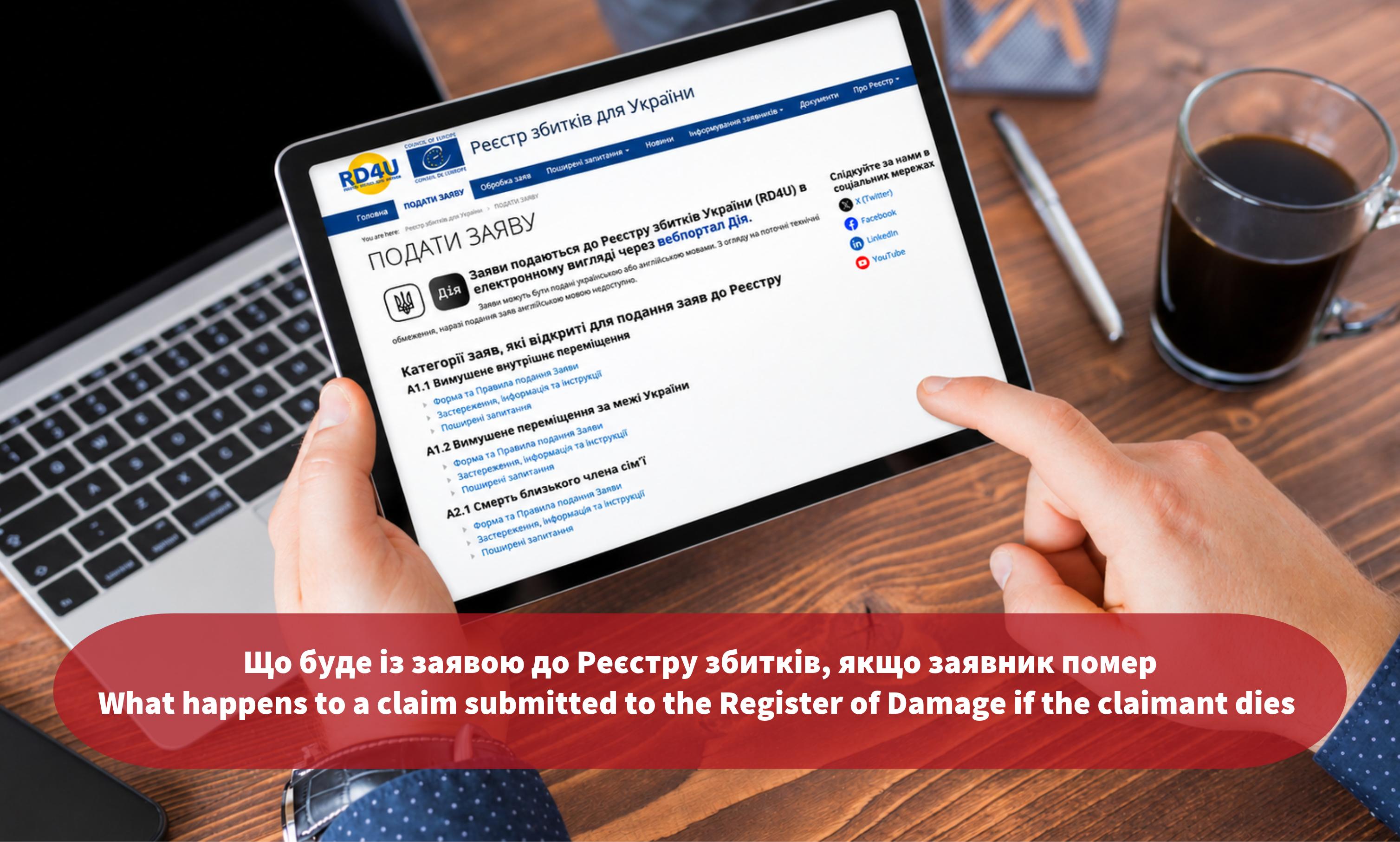
Separate Rules Governing the Succession to Claims submitted to the Register of Damage Caused by the Aggression of the Russian Federation Against Ukraine (RD4U) have finally been approved. They were adopted by the Conference of Participants of the Register on 26 October 2026. Until then, an important practical question remained: what happens to a claim if a person submitted it to the Register but died before the compensation process was completed? Or if a person suffered property or economic losses during their lifetime but did not manage to submit a claim? For the first time, the new Rules specifically establish which close family members may continue this process and under what circumstances.
If the claimant dies after submitting a claim to the Register of Damage
If a person submitted one or more claims to the Register of Damage during their lifetime and subsequently died, a close family member may submit a request for succession to the claims. This applies to claims already submitted by the deceased person to the Register, provided that the person did not withdraw them and the Board of the Register did not reject them. If the successor's request meets the requirements, the Secretariat will attach it to all relevant claims submitted by the deceased person. However, this does not mean that entitlement to compensation is automatically recognised or that compensation will be paid. Attaching a successor to a claim does not determine whether the underlying claim is justified, nor does it establish who will receive compensation in the future or in what amount. These matters are to be decided by the international compensation mechanism.
Who can become a claimant's successor?
The Rules define close family members as including:
- the deceased person's parents, including biological parents, adoptive parents, and stepfathers or stepmothers;
- a husband or wife to whom the deceased person was legally married;
- a civil partner;
- children (biological children, adopted children, stepsons or stepdaughters).
Important! Under the Register's Rules, the term “civil partner” covers a person who, at the time of death, had a long-standing close relationship with the deceased person, lived together and maintained a shared household, shared significant expenses, provided mutual support, or demonstrated other characteristics of a family relationship. Various forms of evidence may be used to establish such a relationship, including court decisions, wills or inheritance documents, proof of cohabitation, joint bank accounts or shared expenses, housing bills, correspondence sent to the same address, photographs, medical and insurance documents, and other materials confirming the family nature of the relationship. This means that the Register will assess not only the formal designation of the relationship but also evidence that it actually existed.
How to submit a request for succession through Diia
The Rules provide that requests for succession will be submitted through Diia.
The applicant will need to confirm:
- their identity;
- their family relationship with the deceased claimant.
Following verification, the successor's request will be attached to the claims submitted by the deceased person during their lifetime. Updates on the status of such a request should also be provided through Diia. However, the new procedure will be introduced in stages. The Rules expressly provide for this. At present, a separate succession service has not yet been published among the available Register of Damage services in Diia.
If several family members wish to become successors
If several close family members submit requests concerning the claims of the same deceased person, the Register will not designate one of them as the primary successor simply because they submitted their documents first. If each request meets the established requirements, all of them will be attached to the deceased person's claims. This also does not mean that any future compensation will automatically be divided equally among these applicants. The new Rules regulate the possibility of continuing a claim in the Register but do not establish how future compensation payments will be distributed among several successors.
Submitting a new claim under A3 categories if the deceased person did not manage to do so
If a person suffered damage, losses or injury during their lifetime but did not manage to submit a claim to the Register, a close family member may submit a new claim in their own name as a successor, but only in relation to losses falling under the A3 categories.
These categories concern property and economic losses, including:
- A3.1 Damage or Destruction of Residential Immovable Property;
- A3.2 Damage or Destruction of Non-Residential Immovable Property;
- A3.3 Loss of Housing or Residence;
- A3.4 Loss of Gainful Employment;
- A3.5 Loss of Individual Enterprise;
- A3.6 Loss of Access or Control of Immovable Property in the Temporarily Occupied Territories;
- A3.7 Other Economic Losses.
Therefore, succession to a claim already submitted by a person during their lifetime is not limited to the A3 categories. By contrast, the Rules expressly provide for the possibility of submitting a new claim after a person's death specifically in relation to losses falling under the A3 categories.
Does succession mean that compensation is already guaranteed?
No. The Register of Damage primarily receives, processes and records claims, but the recording of a claim in the Register does not in itself constitute a decision to award compensation.
Important! The new procedure should not be equated with the automatic inheritance of future compensation.
Lawyers on the platform under Compensation for Destroyed Housing and Property provide free legal consultations to people affected by the war on compensation for damaged and destroyed property, including claims submitted to the Register of Damage (RD4U), and explain which documents and applications are required. If you need to formalise an inheritance following the death of a loved one, you can find a legal specialist under Inheritance Matters.