RD4U step by step: Application in category A3.6 Loss of access or control of immovable property in occupied territories
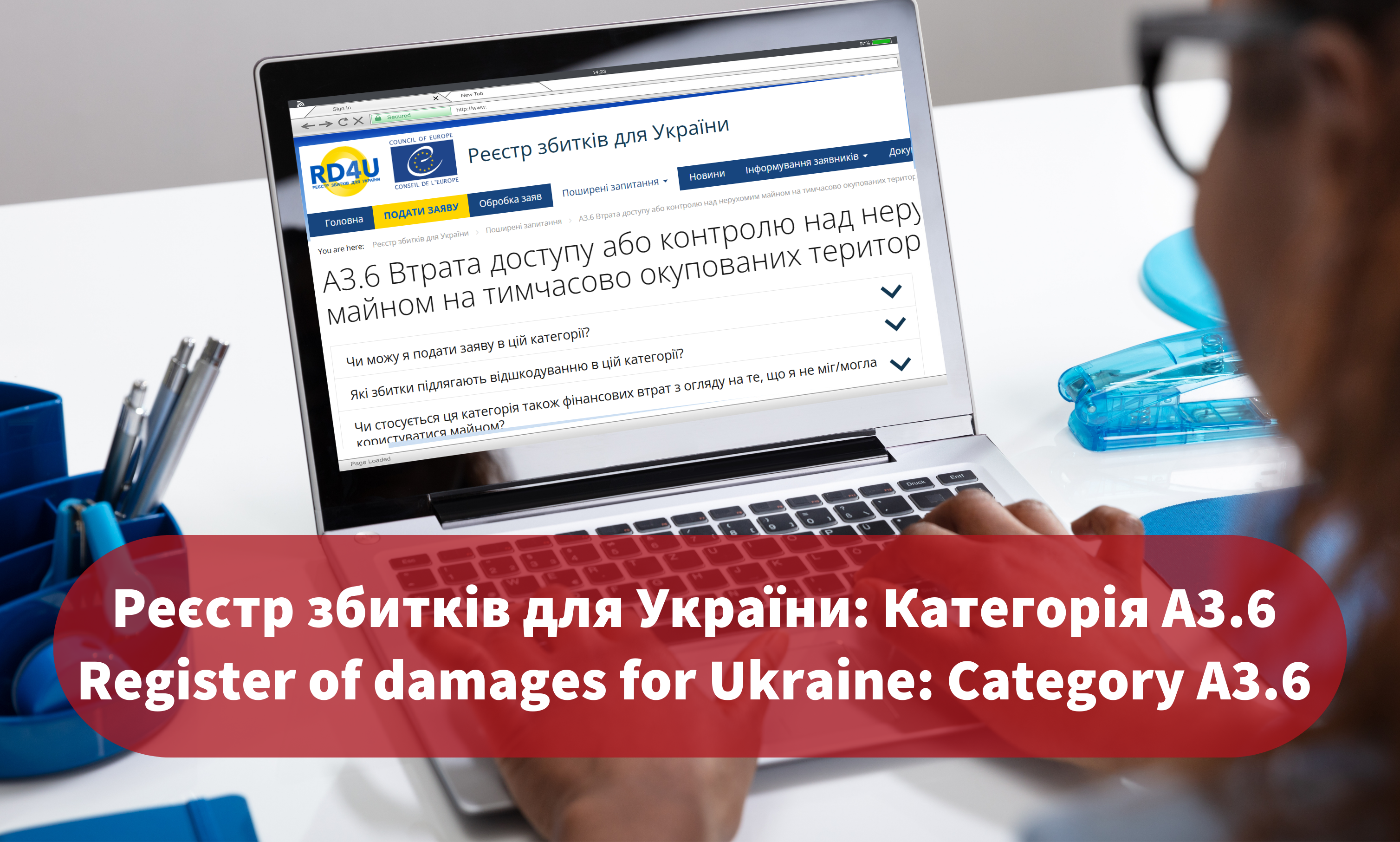
Due to the war in Ukraine, hundreds of thousands of Ukrainians have been forced to leave their homes, businesses, farms, and other real estate located in territories that have come under occupation. Not all property has been destroyed or damaged. A significant part of the real estate has remained intact; however, the owners have lost access to or control over their property: they cannot reach the location, use it, receive income from it, or manage it.
It is precisely for such situations that, within the framework of the international compensation mechanism of the Register of Damage for Ukraine (hereinafter – the Register or RD4U), a specific category has been approved – A3.6 “Loss of access to or control of immovable property in the temporarily occupied territories.”
This category is an important legal instrument that recognizes that the loss of control over property constitutes a separate form of damage, even if the building itself has not been destroyed. Submitting a claim under category A3.6 is not merely a formal action but a legal step aimed at documenting a violated right, which will be relevant for the future compensation mechanism.
In this article we explain category A3.6:
- eligibility criteria for submitting a claim;
- who may submit a claim;
- what damage may be compensated and the types of property concerned;
- what conditions and documents are required;
- the procedure for submitting a claim through the Diia portal;
- how to avoid common mistakes when completing the form.
Eligibility criteria for submitting a claim
A claim in category A3.6 may be accepted for consideration if the loss of access to or control over immovable property occurred:
- on or after 24 February 2022;
- within the territory of Ukraine, within its internationally recognized borders, including territorial waters;
- as a result of internationally wrongful acts of the Russian Federation in Ukraine or against Ukraine.
Who may submit a claim in category A3.6
A claim in category A3.6 may be submitted by a natural person (citizen) who is the owner or co-owner of immovable property to which access or control has been lost. If the property has several co-owners, each of them must submit a claim separately. If a person owns several immovable property objects to which access has been lost, a separate claim must be submitted for each property.
Claims on behalf of minor children or persons under guardianship or trusteeship are submitted by legal representatives in accordance with the Rules on Representation.
Ownership may be confirmed by:
- information automatically retrieved from the State Register of Property Rights (SRPR);
- documents available to the claimant confirming ownership (contract, certificate, court decision, etc.) together with a refusal by the state registrar to enter the information into the SRPR (attached to the claim).
What damage may be compensated and the type of property concerned
Under category A3.6, compensation concerns damage related to the value of immovable property to which the owner has lost access or control due to the occupation of the territory. This category does not cover damage or destruction of immovable property and does not include other related losses. Claims regarding such circumstances must be submitted in other categories, in particular A3.1 or A3.2, depending on the type of damage.
Claims may be submitted for residential houses, apartments, land plots (this part of the claim is still under development), utility buildings, other immovable property that remains in a territory which has become inaccessible for lawful use and management.
Conditions and documents required before submitting a claim
Before submitting a claim, it is important to collect basic documents confirming ownership, the circumstances of the loss of access, and the approximate value of the property as of before 24 February 2022. This will help complete the claim correctly.
1) Documents confirming ownership may include:
- information from the SRPR;
- a certificate of ownership or inheritance;
- a sale and purchase agreement, exchange agreement, gift agreement, etc.;
- a court decision recognizing ownership.
If the originals or copies of documents are unavailable, it is necessary to briefly explain the reason: “documents lost during evacuation,” “destroyed together with the house,” “no access to archives due to occupation.”
In such cases, alternative evidence may be attached: photographs of the property, statements from neighbours, receipts for utility payments, certificates or letters from local authorities.
2) Evidence of loss of access or control may include:
- official information on the occupation of the settlement (for example, from the List of territories where hostilities are (were) conducted or temporarily occupied by the Russian Federation approved by the Ministry for Communities and Territories Development of Ukraine);
- statements from neighbours, village heads, community leaders, or other persons who can confirm the circumstances;
- photographs, videos, satellite images;
- official publications or media reports confirming the absence of control;
- documents confirming attempts to return to the territory or refusals to cross borders or checkpoints;
- information indicating the risk of loss of property as a result of recognition as ownerless by authorities appointed by the Russian Federation in the occupied territories.
These documents should demonstrate that the owner is objectively deprived of the possibility to use the property due to occupation or hostilities, rather than for personal reasons.
3) Evidence of the value of the property may include:
- a property valuation certificate from the website of the State Property Fund of Ukraine (issued free of charge);
- a property valuation report (if available);
- information from other documents confirming the value of the property (contracts, receipts, invoices, or a written estimate of the calculated value).
4) Resources required for submitting a claim online through the Diia portal
- a stable Internet connection to avoid interruptions while completing the form or uploading documents;
- an electronic signature (QES / Diia.Signature / BankID) to verify identity. If a QES is not available, it must be created;
If you do not have a QES, you need to create one. Detailed information on creating a QES is provided in our informational article.
- use a laptop or computer, as the form contains many sections and it may be inconvenient to complete on a phone;
- prepare all necessary files in advance. Scan or photograph documents and ensure that they open correctly and are clearly visible.
Files should be logically named (for example: “house_purchase_contract.pdf”, “inheritance_certificate.jpg”) to make them easier to identify during upload. Documents must be in .jpg, .png or .pdf format and no larger than 3 MB.
Procedure for submitting a claim on the Diia portal
Step 1. Log in to the Diia portal and select the service “Claim in category A3.6 ‘Loss of access or control of immovable property in the temporarily occupied territories”
- Open the service page and register or log in.
- Review the description of the category in Diia and/or the RD4U FAQ to confirm the conditions.
Step 2. Complete the “Applicant information” section
- Full name, date of birth, passport details, tax identification number, contacts, address of registration/residence.
- Currently, a claim may also be submitted via the Diia portal in the interests of a child.
Step 3. Complete the “Property information” section
- Type (residential/non-residential); exact address; area; number of floors; number of rooms; year of commissioning.
- Form of ownership and information on co-owners. Geographical location (geotag).
- The geolocation is generated automatically and should be checked.
Step 4. Describe the “Event/circumstances of loss of control”
- Specific date (or earliest known date) of loss of access.
- Description of what happened: occupation, threat to life, prohibition of entry, “nationalization” by authorities appointed by the Russian Federation in occupied territories, etc.
- Provide references to sources of information (official announcements, media reports, etc.).
Step 5. Upload documents
- Upload files separately: proof of ownership, evidence of loss of control, materials confirming property value (if available).
- Ensure that the files open and are readable.
Step 6. Check everything before submission
Confirm that:
- all required fields are completed;
- dates and addresses are consistent across sections;
- the data in the documents matches the information in the form
- all attachments have been added.
Step 7. Submit the claim
- Click “Submit” and sign the claim with your electronic signature (QES).
- Confirmation and a unique claim number will appear on the screen and/or be sent to your email or the Diia application.
Step 8. Follow the review process
- The Register checks the form and evaluates the evidence against the eligibility criteria.
- If the claim meets the requirements, confirmation of acceptance will be sent.
- Subsequently, the claim will be reviewed by the Compensation Commission, which will be established as the successor to the Register.
Step 9. Save confirmation
- Record the claim number and keep a PDF copy of the submitted package and all attached files (locally and in cloud storage if desired).
- The claim is stored in the personal account on the Diia portal in the section “Services” – “Ordered services.”
How to avoid common mistakes when completing the electronic form
Submitting a claim through the Diia portal is simple but legally significant. Any mistake may lead to refusal to accept the claim or affect future compensation.
The most common mistakes include:
1.Incorrect category.
If the property is destroyed, select category A3.1 for residential property or A3.2 for non-residential property. In uncertain situations, submit under A3.6 with an explanation that the condition of the property is unknown due to occupation.
2.Errors in personal data.
Provide and verify your name exactly as indicated in the passport, correct tax identification number, current phone number, and email address. Personal information is often filled automatically, but it should still be checked.
3.Absence of ownership documents.
Even a copy of a contract, a certificate from the Bureau of Technical Inventory, or other available evidence is better than nothing. If documents are lost, explain when and how the property was acquired.
4.Too brief description of the event.
Do not simply write “the territory is occupied.” Specify the date, circumstances, and actions taken. For example:
“After March 2022 the district was blocked by the armed forces of the Russian Federation, access is prohibited, neighbours confirm that the house cannot be accessed.”
5.File errors.
Do not upload archives or unreadable photographs. Allowed formats: .pdf, .jpg, .png.
File names should be clear, for example: “house_purchase_contract.pdf”.
6.Absence of an approximate property value.
Indicate at least an approximate amount based on market prices in your region as of February 2022.
Prospects for receiving compensation
The Board of the Register of Damage considers claims at regular quarterly meetings. During the review, the Board decides exclusively on the admissibility of claims for entry into the Register, assessing their compliance with the criteria set out in the Register’s governing instruments.
The Board does not determine liability, does not assess the amount of damage, and does not award compensation.
Claims may be reviewed individually or in groups that share similar legal or factual characteristics. In its work, the Board may also take into account decisions of international courts or similar bodies if relevant to admissibility.
Following consideration, the Board adopts one of four decisions:
- to enter the claim into the Register;
- to return it to the Secretariat with instructions for further processing
- to reject it without prejudice, allowing resubmission after deficiencies are corrected;
- to reject it with prejudice, which prevents resubmission.
The Board’s decision is final, and the claimant receives notification through Diia and by email. All claims found admissible are entered into the Register of Damage for Ukraine and will later be considered by the Compensation Commission, which will be established as the successor to the Register and will decide on liability and compensation.
Compensation will be paid after the establishment of the compensation mechanism and the adoption of the relevant decision by the Compensation Commission.
If you have questions regarding submitting claims to the Register, please seek consultation via this link.
This material was created by the NGO “STEP” in partnership with the Danish Refugee Council with funding from the European Union. The views and opinions expressed are those of the author(s) alone and do not necessarily reflect the views of the European Union or the DRC. Neither the European Commission nor the DRC can be held responsible for the content of this material.

