Issues relating to the use of the housing voucher
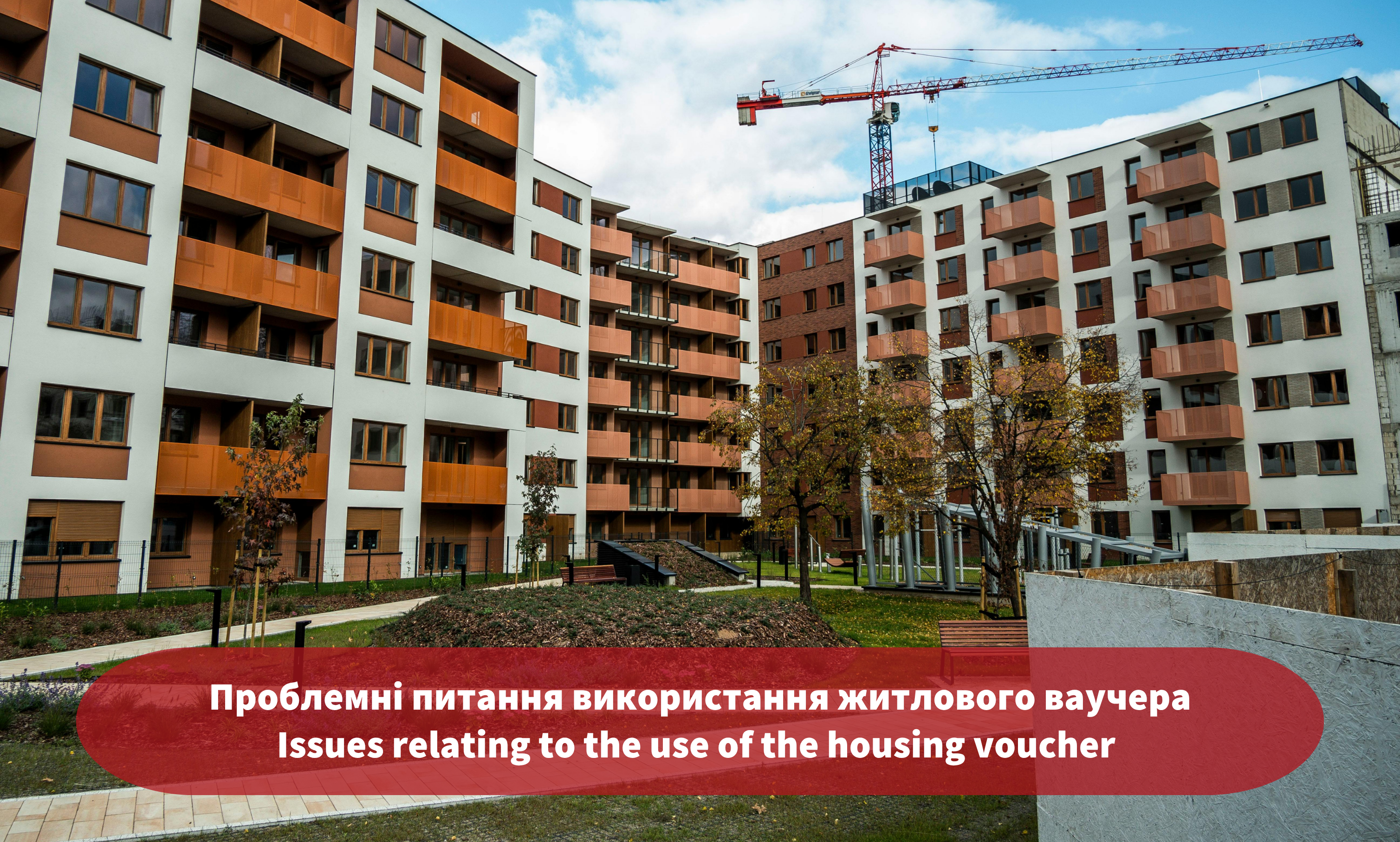
Because of the war, many people have been forced to leave their homes and evacuate, have lost their housing as a result of shelling, fires and destruction, or are unable to return home because of temporary occupation.
Since 2025, a state housing assistance mechanism — the housing voucher — has been available to certain categories of internally displaced people who lived in occupied territories. Currently, two categories of IDPs are eligible to use housing vouchers:
• combatants;
• persons with disabilities as a result of war.
You can learn more about what a housing voucher is and the main conditions for receiving one in our previous publications, “Housing vouchers for the purchase of housing for certain categories of IDPs from occupied territories” and “Housing voucher and eVidnovlennia housing certificate: what is the difference and what do they have in common”.
Currently, many people are interested in the following question: can two or more housing vouchers be combined to purchase one apartment or house? In this article, we explain how this works, who can combine vouchers and what future co-owners of the housing should take into account.
Stages of receiving and using a housing voucher
The issuance of a voucher is only the first stage.
The person then independently chooses an apartment, residential house or another property that can be purchased under the programme conditions. The state does not provide a ready-made list of available housing or allocate a specific apartment to the voucher holder.
Important! A housing voucher cannot be sold, gifted, transferred to another person or used by another person instead of the holder. It is valid for five years from the date of its issuance. Personal funds or a loan may also be used to purchase housing.
The second stage, after choosing housing, is to submit a request for funding for its purchase. The order in which funding is provided depends not on the date when the voucher was issued, but on the date when the request for funding was submitted. This means that a person may have held a voucher for some time, but their position in the funding queue will be determined specifically by the time when the request for funding is submitted.
Once funding is confirmed, the relevant amount is reserved for 60 calendar days. During this period, an agreement for the purchase of housing must be concluded. The funds are not transferred to the voucher holder but are directed only to the housing seller or creditor after the agreement has been notarised.
Important! It is at the stage of submitting the request for funding that several vouchers can be combined to purchase one property.
Combining several housing vouchers
How:
Several recipients of assistance may jointly submit a request for funding. The request specifies all housing vouchers that they intend to use to purchase one apartment or house. In practice, this makes it possible to combine the state support provided to several people within a single transaction.
For example:
• one housing voucher — up to UAH 2 million in state assistance;
• two vouchers — up to UAH 4 million;
• three vouchers — up to UAH 6 million.
This may be particularly relevant in large cities where housing prices are significantly higher than the amount of state assistance, where several people plan to live together, or for families for whom one voucher is insufficient to purchase housing that meets their needs.
Who:
A separate question is who exactly can use this mechanism.
Currently, there is no requirement that housing voucher holders must be members of the same family, share a household or live together before purchasing the housing.
The only condition for submitting a joint request is that each person has the status of a recipient of assistance and intends to purchase the same property.
Therefore, a joint request may be submitted, for example, by:
• spouses;
• parents and adult children;
• brothers and sisters;
• other relatives;
• people who are not related to each other but plan to make a joint purchase.
In other words, housing vouchers are combined not so much on the basis of family relationships as on the basis of a common purpose.
Who will own the property:
At this stage, another important question arises — who will own the purchased housing and what share each person will have.
The procedure for using housing vouchers does not establish a separate formula for distributing shares among several purchasers. The mere fact that two or more vouchers were used for the purchase does not automatically result in equal shares and does not determine the proportion of those shares. Therefore, this issue should be regulated when the agreement is concluded, taking into account the provisions of applicable legislation.
For example:
If two people each use one housing voucher worth UAH 2 million, but one of the purchasers additionally contributes UAH 1 million of their own funds, the question arises as to whether each of them should receive half of the property or whether the person who contributed the additional funds should have a larger share.
The programme does not establish a specific rule for such a situation. Therefore, it is advisable to determine the shares before signing the agreement and clearly record the arrangement in the agreement. Failure to clearly determine the shares may lead to disputes over the use, sale or division of the housing.
Sources of funding:
Since state funding may be only one source of financing alongside personal savings or a loan, a person may use a housing voucher to cover part of the cost of the housing and pay the remaining amount using their own funds. This approach may also be used when combining several vouchers.
For example:
Two recipients of assistance have housing vouchers with a total value of UAH 4 million, but the apartment they have chosen costs UAH 5.5 million. The remaining UAH 1.5 million may be paid using their own funds or credit funds.
What should you pay attention to?
The main challenges associated with the use of housing vouchers for IDPs in Ukraine remain insufficient state funding for the programme, technical errors in real estate registers and certain legislative restrictions on combining vouchers with the preferential eOselia mortgage programme. Therefore, when planning to participate in the programme, it is worth taking the following into account:
Amount limitation: the nominal value of one housing voucher is UAH 2 million. In large cities or regions with high real estate prices, this amount may be insufficient.
Archive errors in the State Register of Rights to Immovable Property: many applications are automatically rejected because of incorrect data in the State Register of Rights to Immovable Property. The system identifies old records, most commonly from 2002–2012, concerning property that a person sold or gifted long ago and treats this as “ownership of housing in government-controlled territory”.
Registration of a special property right: if you plan to purchase housing in a new development, the developer must have the special property right duly registered. If this right has not been registered, the notary will refuse to notarise the transaction.
If you need advice or assistance on matters related to a housing voucher, you can book an online consultation with a lawyer.
This informational material was created within a project implemented by the Charitable Organisation Charitable Foundation “Caritas Kharkiv” in cooperation with the Danish Refugee Council (DRC), with financial support from the European Union. The views and opinions expressed are solely those of the Charitable Organisation Charitable Foundation “Caritas Kharkiv” and do not necessarily reflect the views of the European Union or DRC.