Housing voucher vs eVidnovlennia housing certificate: what is the difference and what do they have in common
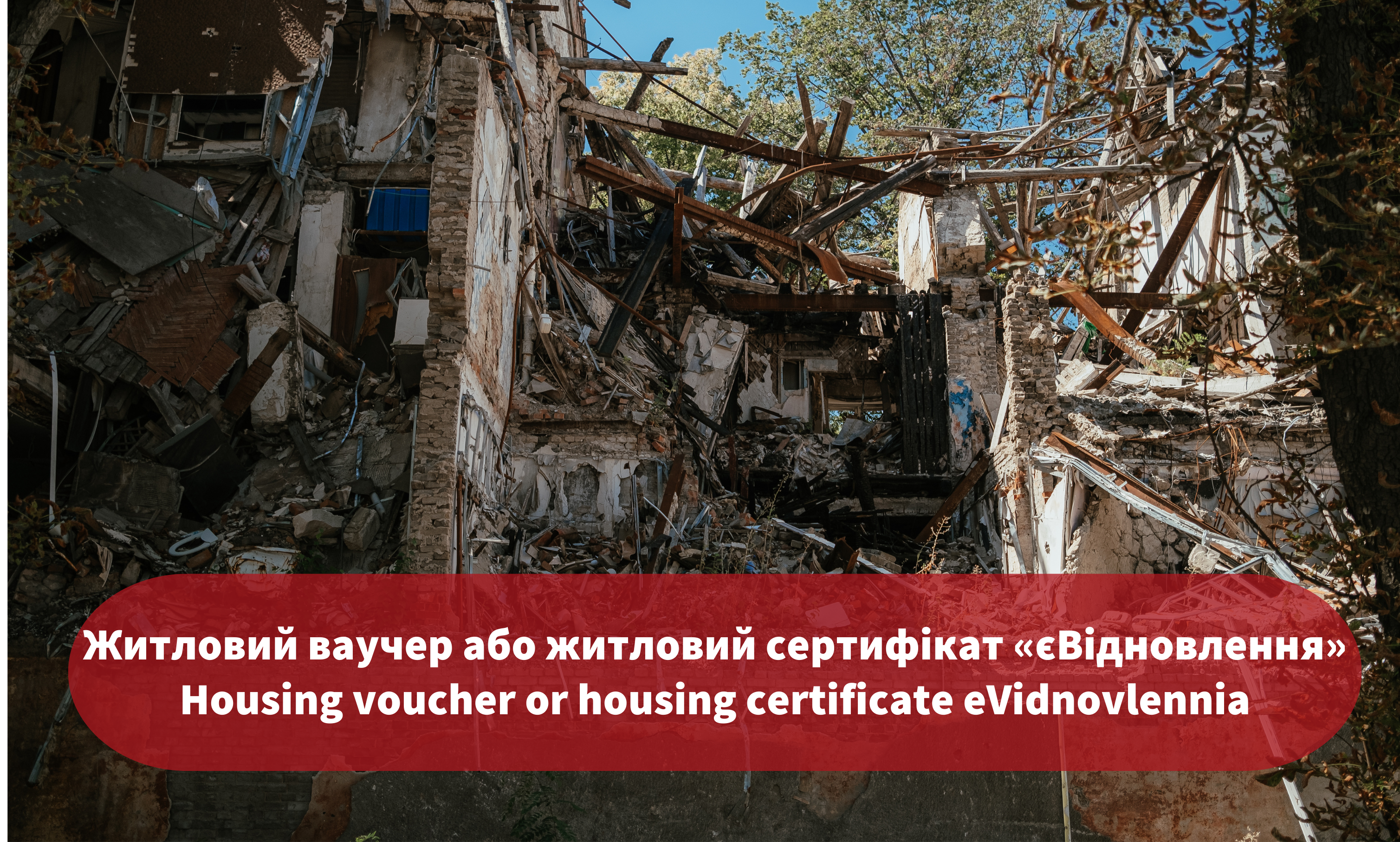
The state has introduced several instruments to provide housing for people whose homes were damaged by the war or remain in temporarily occupied territories. The most widely discussed among them are the housing voucher and the eVidnovlennia housing certificate.
Despite having a similar goal - to provide people with housing - these instruments differ significantly in terms of eligibility grounds, categories of beneficiaries, and program conditions.
Purpose of the introduced instruments
A housing voucher is a form of state assistance aimed at providing housing for certain categories of internally displaced persons (IDPs) who previously lived in occupied territories, including regions that have been occupied since 2014, and who do not have their own housing after displacement.
The amount of assistance is fixed — UAH 2 million per beneficiary, regardless of the type of housing.
The program conditions are set out in Resolution No. 1176 of 22 September 2025 (hereinafter – Procedure No. 1176).
The eVidnovlennia housing certificate is a form of state compensation for housing belonging to citizens that was located in the territory controlled by Ukraine and destroyed as a result of hostilities starting from 24 February 2022.
The amount of compensation is calculated individually — taking into account the type of property (house or apartment), its area, technical characteristics, and region.
The program conditions are defined in Resolution No. 600 of 30 May 2023 (hereinafter – Procedure No. 600).
Who сan receive the assistance
Recipients of a housing voucher may include:
- combatants from among internally displaced persons, defined in paragraphs 19–25 of Part 1 Article 6 of the Law of Ukraine “On the Status of War Veterans and Guarantees of Their Social Protection”, who participated in ATO/JFO operations or the defence of Ukraine between 2014 and 2025;
- persons with disabilities as a result of war from among internally displaced persons, defined in paragraphs 11–16 of Part 2 Article 7 of the same law.
Please note! These individuals may participate in the program regardless of whether they own housing in temporarily occupied territories and regardless of its condition.
The following persons are eligible for compensation in the form of an eVidnovlennia housing certificate:
- owners or co-owners of destroyed housing;
- their heirs.
Please note! Procedure No. 1176 and Procedure No. 600 contain restrictions on the categories of persons who may participate in the respective programs.
Key participation conditions
- For the housing voucher, the key condition is the following: the beneficiary or members of their family (one of the spouses, children under 18 years of age) must not have housing in the territory controlled by Ukraine. Residential real estate located in areas of active hostilities or in temporarily occupied territories, as well as residential real estate purchased through mortgage loans that remain unpaid, are not taken into account.
- To receive an eVidnovlennia housing certificate, a person must be a verified owner of destroyed housing and have confirmed ownership information recorded in the State Register of Rights to Immovable Property. The existence of other housing (except for the destroyed one) is not a ground for refusal to issue a housing certificate.
Therefore, the housing voucher and the eVidnovlennia housing certificate are two different instruments aimed at different categories of people affected by the war in Ukraine.
The housing voucher is focused on providing housing for combatants and persons with disabilities as a result of war among IDPs from temporarily occupied territories starting from 2014, whereas the eVidnovlennia housing certificate is aimed at owners of housing destroyed after 24 February 2022.The possibility of participating in each program depends on a person’s status, the date, place and reasons for the loss of housing, and its verified status.
What housing vouchers and eVidnovlennia certificates have in common
Housing vouchers and the eVidnovlennia housing certificate are similar in that they are instruments of non-cash state support aimed at purchasing new housing instead of housing lost due to the war, despite the different status of housing and the different reasons for its loss.
An application for state assistance in the form of a housing voucher and state compensation in the form of an eVidnovlennia housing certificate can be submitted through the Diia mobile application.
To submit an application for a housing voucher, in the Diia mobile application it is necessary to use the service “Services for IDPs” and select “Application for a Housing Voucher.”
To submit an application for an eVidnovlennia housing certificate, in the Diia mobile application it is necessary to use the “eVidnovlennia” service and select “Report Damaged Housing,” and after submitting the notification proceed to “Application for Payments” and follow the next steps to select compensation in the form of a housing certificate.
Both documents have a targeted purpose and are valid for five years, cannot be transferred to third parties, and allow the purchase of housing on the primary or secondary market in safer territories controlled by Ukraine.
The following common requirements also apply to beneficiaries of both programs: the absence of sanctions, restrictive measures, and criminal convictions for relevant criminal offenses.
Housing purchased using a housing voucher or an eVidnovlennia housing certificate cannot be alienated for five years.
Earlier, we published an article explaining the reasons for introducing housing vouchers and the general conditions for receiving them. You can review the previous material via the link.
If you need legal advice or assistance, you can schedule an online consultation with a lawyer through the PravoVsim platform.
This material was created by the Charitable Foundation “Caritas Mariupol” in partnership with the Danish Refugee Council with funding from the European Union. The views and opinions expressed are those of the author(s) alone and do not necessarily reflect the views of the European Union or the DRC. Neither the European Commission nor the DRC can be held responsible for the content of this material.