Injuries from shelling: how to properly document an injury and report it to law enforcement
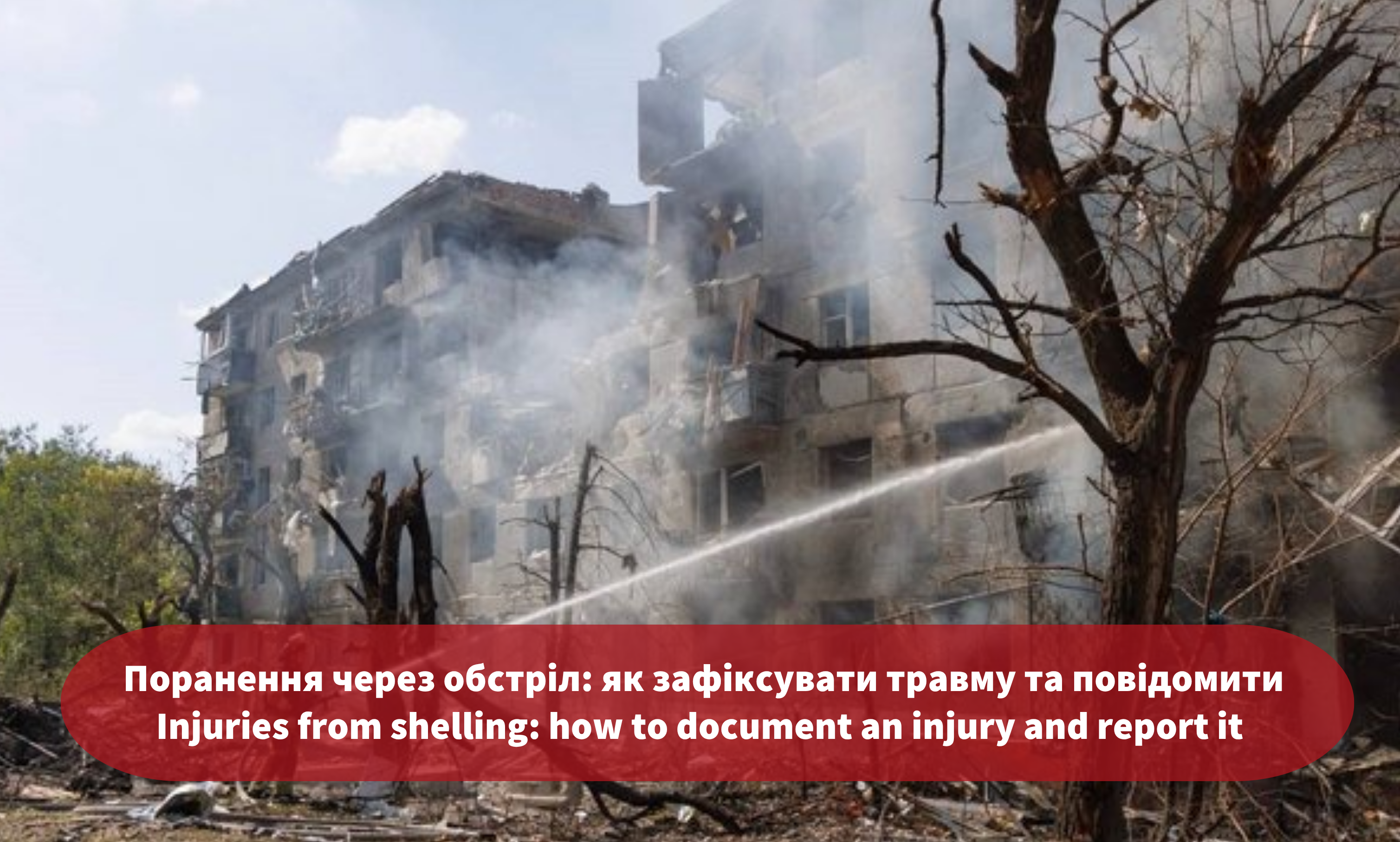
After sustaining an injury as a result of shelling or an explosion, the most important thing is to receive medical assistance. At the same time, it is important to properly document the circumstances and consequences of the injury. Medical records and reports to law enforcement authorities may be required to receive compensation, financial assistance or obtain the status of a person with a disability as a result of war. This article explains what steps should be taken after sustaining an injury and which documents are important to collect.
Step 1. Receive medical assistance
First aid provided at the scene by military personnel, volunteers or representatives of humanitarian organisations can save lives, but it is not accompanied by the issuance of documents in the prescribed form. Therefore, even if you received assistance at the scene, we recommend seeking medical assistance from a healthcare facility.
Where to start:
1. Undergo a medical examination even if there are no visible injuries.
After an explosion or shelling, some injuries may not be immediately apparent. In particular, this may include acoustic barotrauma (blast injury), internal injuries or other consequences of a blast wave. Seeking medical assistance will help identify possible hidden injuries and document your health condition.
2. Tell the doctor about the circumstances in which you sustained the injury.
Make sure that the medical records clearly indicate the cause of the injury, for example:
- "injury sustained as a result of a mine or explosive blast";
- "due to enemy shelling";
- "as a result of an ammunition explosion".
If the documents indicate, for example, "domestic injury" or "general illness", ask the healthcare professional to check and correct the wording to reflect the actual circumstances in which the injury was sustained. Proper documentation of the circumstances of the injury may be important for subsequently establishing its link to hostilities.
3. If a doctor recommends hospitalisation, do not refuse it without compelling reasons.
Hospitalisation may be necessary for treatment and for documenting the nature of the injuries sustained. In addition, it may be a requirement for participation in certain local or regional compensation programmes.
If you are being pressured to sign a refusal of hospitalisation, document this fact where possible and contact the management of the healthcare facility.
Step 2. Collect medical documents
The collection of medical documentation begins from the first day of the incident. Depending on where and what type of medical assistance you received, you may need different documents.
If assistance was provided by an emergency medical team:
- Emergency Medical Care Call-Out Record (Form No. 110/o). This is the primary document recording the time, location, reason for the call, medical history (including the circumstances in which the injury was sustained), examination results and preliminary diagnosis.
- Detachable Section of the Accompanying Form (Form No. 114/o). This is completed only when a patient is transported to a hospital for inpatient treatment.
Please note: these forms constitute internal medical documentation. The originals are kept at the emergency medical care station and are NOT provided directly to the affected person after medical assistance has been provided. You or your legal representatives have the right to request certified copies by submitting the relevant application, if necessary. A template application is available via the link provided in the original material.
If you received inpatient treatment:
- Extract from the Medical Record of an Inpatient (Form No. 027/o). It must contain a diagnosis according to the International Classification of Diseases (ICD-10) linked to hostilities (for example, Y36 "Injuries due to war operations"), with the type of injury specified.
- Results of diagnostic imaging and other instrumental examinations (images and their reports). Be sure to obtain the images/discs (CT, MRI, X-ray) and the corresponding written reports. The images provide evidence of the presence of foreign bodies (metal fragments) or tissue damage.
- Extract from the Register of Surgical Procedures Performed in an Inpatient Facility (Form No. 008/o). If you underwent surgical procedures while in hospital (for example, removal of fragments, suturing of blood vessels, amputation or bone fixation), each such surgical procedure is recorded on a separate sheet in the register of surgical procedures performed in the inpatient facility. The register itself is an internal record of surgical procedures, so the original is not provided to the patient. However, you may obtain an extract from the register or a certified copy of the entry (sheets) concerning the procedures performed during inpatient treatment. A template application is available via the link provided in the original material.
- Specialist Consultation Reports (Form No. 028/o). If you were examined by other medical specialists during treatment (a surgeon, traumatologist, neurologist, ophthalmologist, otolaryngologist, etc.), request their specialist consultation reports. Obtaining such reports is particularly important in cases of blast injuries (acoustic barotrauma), where there may be no external wounds but damage to the auditory or optic nerve, concussion or neurological disorders may be present.
If you are receiving outpatient treatment:
- Outpatient Medical Record (Form No. 025/o) and an extract from it (Form No. 027/o) or an Extract on a Wound (Injury) from the Electronic Health Care System (eHealth), which must indicate the circumstances of the incident as reported by the patient and the ICD-10 code (Y36).
- Electronic referrals for additional examinations and appointments with specialised healthcare professionals.
Please note: any notifications or operational information concerning your injury that a hospital or family doctor provides to law enforcement authorities constitute solely internal interaction between those institutions. Under procedural law, such interaction does not automatically result in obtaining victim status in criminal proceedings or the issuance of the relevant supporting documents.
Step 3. Notify law enforcement authorities
While receiving treatment or rehabilitation, or after your health condition has stabilised, you should report the criminal offence to law enforcement authorities. This is important for officially documenting the circumstances of the incident and subsequently confirming your status as a victim in criminal proceedings.
Where to start:
1. First, you should obtain from the police a notification slip confirming the receipt and registration of a statement (report) of a criminal offence or other incident.
Please note: a notification slip from the Unified Record only confirms that you contacted law enforcement authorities. It does not indicate that the competent authorities have initiated a pre-trial investigation.
2. Obtain an extract from the Unified Register of Pre-Trial Investigations (URPTI).
After reporting the wound or injury to the police, you should contact the Security Service of Ukraine (SSU), as it is the authority responsible under the law for investigating war crimes.
There are two ways to obtain victim status, and the type of application to be submitted depends on the circumstances in which the wound (injury) was sustained:
- If criminal proceedings concerning the incident have already been initiated (for example, following reports from the State Emergency Service of Ukraine (SESU), local authorities or a hospital), an Application to Be Involved in the Proceedings as a Victim should be submitted.
- If the incident was isolated or occurred in an unpopulated area, a Statement of Criminal Offence should be submitted.
The application must be accompanied by good-quality copies of all medical documents collected that confirm the fact and nature of the injury, as well as copies of identity documents. The application and attachments should be submitted to the SSU at the place where the injury was sustained. For example, if the injury was sustained in Zaporizhzhia Oblast, the application should be submitted to the SSU Office in Zaporizhzhia Oblast.
The application may be submitted:
- In paper form during an in-person visit.
Prepare good-quality copies of all attachments to the application in advance. Bring an identity document as well as the originals and copies of the documents. The originals are required so that the authorised officer can verify the copies against them.
Please note: for security reasons, in-person reception may not be available at most regional SSU offices. Before visiting, we recommend checking whether the relevant office accepts applications in person. Contact details for regional SSU offices are available on the official SSU website.
- Electronically to the official email address.
When submitting documents electronically, we recommend combining the application and the attached documents into a single PDF file and signing it with a Qualified Electronic Signature (QES). We have explained in detail what an electronic signature is and how to create one in a separate PravoVsim information article. Up-to-date email addresses of regional SSU offices are available on the official SSU website.
- In paper form by post.
Prepare the application, good-quality copies of identity documents and copies of all attachments. Copies may be certified with the following wording: "True copy of the original, surname and initials, date, personal signature". We recommend sending the application and attachments by JSC Ukrposhta as a valuable letter with declared value and an inventory of enclosures.
Please note: why is it important to send the documents with an inventory of enclosures? Unlike an ordinary or registered letter, an inventory of enclosures certified by a postal stamp records the list of documents you have sent. We recommend confirming the current correspondence address through the hotline of the relevant regional SSU office. Contact details are available on the official SSU website.
3. Check the information in the extract from the Unified Register of Pre-Trial Investigations.
Within 24 hours after the statement has been received, the information must be entered into the Unified Register of Pre-Trial Investigations (URPTI), and you must be provided with an extract from the URPTI. Make sure that the extract contains your surname, the date and exact address of the incident, and a description of the injuries sustained.
If you need an individual consultation or legal assistance on matters related to the consequences of the war, you can book an online consultation with a lawyer through PravoVsim.
This information material was developed within a project implemented by the NGO "STEP" in cooperation with the Danish Refugee Council (DRC) with funding from the European Union. However, the views and opinions expressed are those of the author alone and do not necessarily reflect the views of the European Union or DRC.