RD4U Step-by-Step: Application under Category A1.1 “Involuntary Internal Displacement”
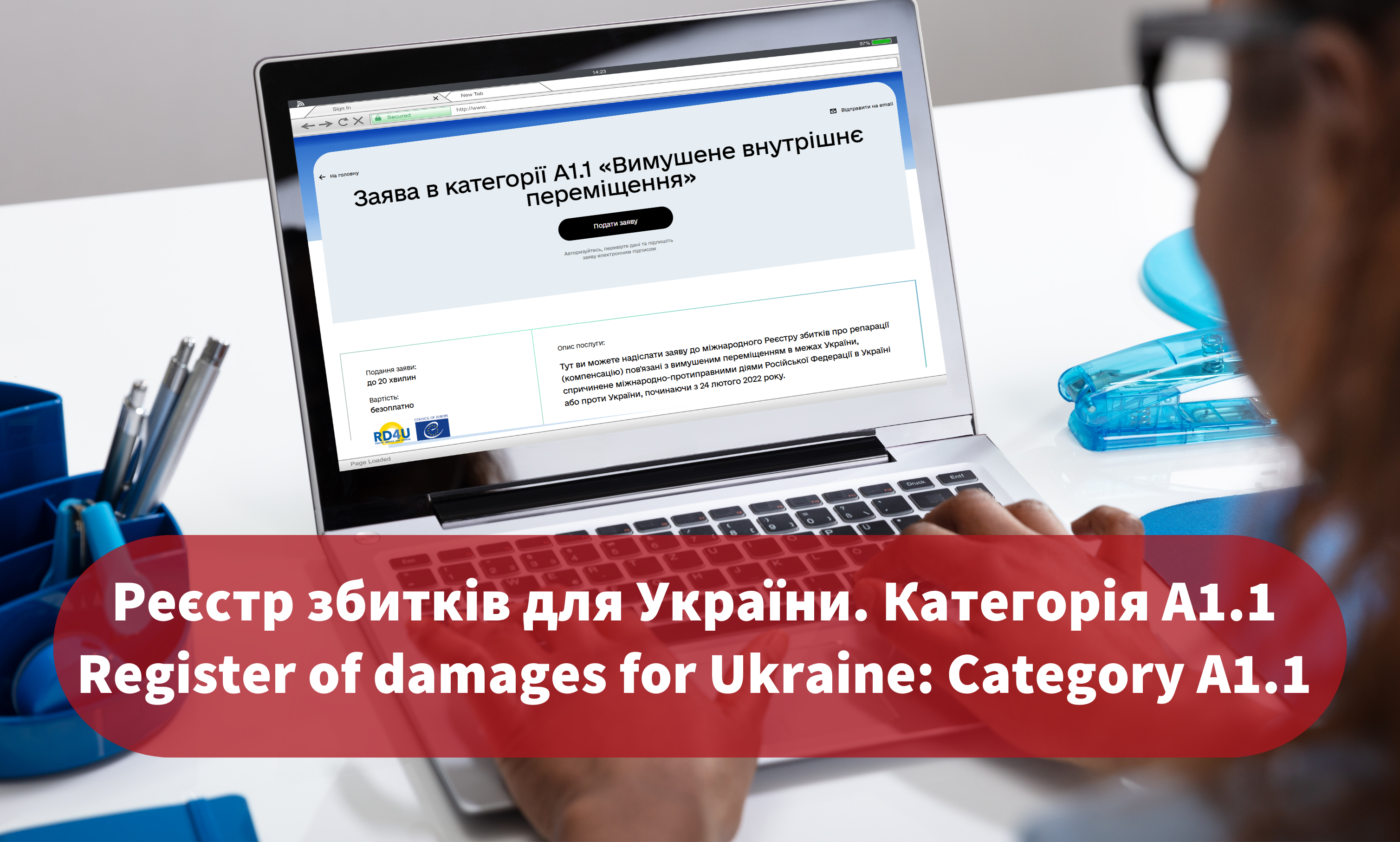
The full-scale war has fundamentally reshaped the security environment for millions of Ukrainians, forcing them to urgently seek new places of residence within the country. For some, this was a planned evacuation; for others, it was a flight from hostilities or the inability to remain at home due to occupation and constant threats to life. Such displacement has become not merely a change of geography, but a profound disruption of daily life requiring proper documentation and legal response within international compensation mechanisms.
To record such cases, the Register of Damage for Ukraine provides for Category A1.1 “Involuntary Internal Displacement.” Its purpose is to document the fact of internal displacement and the circumstances under which a person was compelled to leave their home. This information will later serve as a basis for the future compensation mechanism, which will assess non-material damage related to forced relocation.
In this article, we explain how Category A1.1 operates, who is eligible to apply, what data and evidence are required, how to submit an application through the Diia portal, and what common mistakes applicants should avoid.
We will cover:
- eligibility criteria;
- who may apply;
- what damage is covered;
- what evidence and documents must be prepared;
- procedure for submitting an application through the Diia portal;
- common mistakes and how to avoid them.
Eligibility criteria
An application under Category A1.1 may be accepted into the Register if:
- the displacement occurred on or after 24 February 2022;
- within the internationally recognised borders of Ukraine, including its territorial waters;
- for reasons relating to the Russian Federation’s internationally illegal actions in Ukraine or against Ukraine. This may include fleeing or departure due to: hostilities, threats to life; occupation; inability to remain safely at the place of residence; the need to avoid the adverse consequences of war.
Who is eligible to apply under Category A1.1
An applicant may be an individual who:
- was compelled to leave their home or place of residence and relocate to another location within Ukraine;
- does not have or did not have the possibility to return to their home from another place within Ukraine due to actions of the Russian Federation or in order to avoid the negative consequences of such actions.
A person who is or was registered for any period as an internally displaced person (IDP) in the Unified Information Database of Internally Displaced Persons of Ukraine is automatically considered an “involuntarily internally displaced person” for the purposes of Category A1.1. If such registration is absent, the applicant must independently provide information and evidence confirming the fact of involuntary internal displacement.
Each involuntarily internally displaced person may submit one application under this category. Even if displacement occurred as a family, each family member must submit an individual application.
Applications on behalf of minor children and persons under guardianship or custody are submitted by their legal representatives.
What damage is subject to compensation
Category A1.1 covers only the fact of involuntary internal displacement and provides for compensation of “moral (non-pecuniary) damage”, the amount of which is not determined by the applicant.
This means that this category does not assess: loss or damage to housing; destruction of property; loss of employment or income; other economic losses. Such claims must be submitted separately under relevant categories.
Category A1.1 is aimed at documenting non-material harm – the fact of involuntary relocation due to the war.
What information and documents should be prepared
Before starting to complete an application under Category A1.1 “Involuntary Internal Displacement”, it is important to prepare all key information and evidence in advance confirming the fact of displacement and the circumstances that forced the applicant to leave their place of residence. This will help complete all sections of the form correctly, avoid inconsistencies, and ensure admissibility of the application.
1. Required information and evidence:
- applicant’s personal data: passport details or other ID, tax number, date of birth, current phone number and email, registered and actual address. Some of this information is automatically retrieved from state registers, but should be verified before submission.
- information on displacement: exact date or period; address prior to displacement; location(s) after displacement; brief description of circumstances (shelling, occupation, threat to life, evacuation, destruction of infrastructure, inability to remain safely).
- IDP registration (if available). Absence of an IDP certificate is not grounds for refusal, but other evidence becomes particularly important.
- supporting evidence (if necessary): certificates from local authorities or military administrations; evacuation documents; communications or instructions to leave; photos/videos; screenshots from official sources; witness statements. Evidence should confirm when, from where, why, and under what conditions return is impossible or unsafe.
2. Requirements for online submission via the Diia portal:
- a stable internet connection is required to avoid interruptions while completing the application form or uploading supporting documents.
- an electronic signature (QES / Diia.Signature / BankID) is required to verify the applicant’s identity. If the applicant does not yet have a qualified electronic signature (QES), it must be created in advance. Detailed guidance on how to obtain an electronic signature is available in our information article at the following link.
- it is recommended to use a laptop or desktop computer, as the application form contains multiple sections, and it may be difficult to review all fields or upload files when using a mobile phone.
- all required documents should be prepared in advance. Documents should be scanned or photographed, ensuring that files are accessible and images are clear and legible. File names should be structured in a logical manner to facilitate navigation during the upload process. Accepted file formats are .jpg, .png, or .pdf, with a maximum file size of 3 MB.
Procedure for submitting an application via the Diia portal:
Step 1. Log in to the Diia portal and select the service “Application under Category A1.1 ‘Involuntary Internal Displacement’.”
- Go to the service page “Application under Category A1.1” and register or log in.
- Briefly review the category description on Diia and/or the RD4U FAQ to verify the conditions.
Step 2. Complete the “Applicant’s Data” section.
- Full name, date of birth, passport details, tax number, contact details; registered/place of residence address.
- Currently, an application via the Diia portal may also be submitted on behalf of a child.
Step 3. Complete the “Information on Involuntary Internal Displacement” section.
- Indicate the date or period when the displacement took place.
- Specify the address of residence prior to displacement (as of the time of the events).
- Indicate the address or locations where you stayed after displacement.
- Provide a brief description of the reasons – hostilities, occupation, threat to life, evacuation, closure of the locality, checkpoints, etc.
- If necessary, add information about family members who were displaced together (but note that each person submits their own application separately).
Step 4. Add information on IDP registration (if such registration is available).
If there is no IDP certificate, more evidence of involuntary internal displacement will need to be provided.
Step 5. Upload documents.
Upload documents confirming the fact of involuntary internal displacement: certificates from authorities, evacuation documents, screenshots of official notifications, letters from organisations, photo/video materials, witness statements.
Step 6. Check everything before submission.
- Whether all mandatory fields are completed;
- Whether dates/addresses are consistent across different sections;
- Whether the data in the documents matches the form;
- Whether all attachments are added.
Step 7. Submit the application.
- Click “Submit” and sign the application with your electronic signature (QES).
- A confirmation and a unique application number will appear on the screen and/or via email/in the application.
Step 8. Monitor the review process.
- The Register reviews the form and assesses the evidence against admissibility criteria.
- If the application is submitted correctly and meets the requirements, confirmation of its acceptance will be received.
- Subsequently, the application will be considered by the Compensation Commission, which will be established as the successor to the Register.
Step 9. Save confirmation.
- Record the application number and save a PDF copy of the submitted package and all attached files (locally and/or in cloud storage if desired).
- The application is stored in the personal account on the Diia portal under “Services” in the subsection “Ordered services.”
How to avoid common mistakes when completing the electronic form
Submitting an application via the Diia portal is simple, but legally significant. Each mistake may lead to refusal to accept the application or affect the future payment of compensation.
Most common mistakes:
1. Incorrect category.
Category A1.1 is intended exclusively to document the fact of involuntary internal displacement. If the application describes destruction or damage to property, loss of access to property, separate categories should be used – A3.1, A3.2, A3.6.
If the applicant stayed abroad for a certain period, a separate category is предусмотрена – A1.2.
2. Errors in personal data.
Indicate and verify your surname, name, and patronymic exactly as in your passport, the correct tax number, and current phone number and email. Personal information will in most cases be filled in automatically, but its accuracy should be checked.
3. Inconsistencies in displacement dates.
The date of departure, the address prior to displacement, and the circumstances that led to departure must be logically consistent, not contradict each other, and correspond to actual events.
4. Too brief description of the reasons for displacement.
Wording such as “occupation”, “shelling” or “danger” without further details is not sufficient. It is important to briefly describe what exactly happened: when hostilities began, what changed in the place of residence, and why it became unsafe to remain there.
5. Errors in files.
Do not upload archives or unreadable photos. Accepted formats: .pdf, .jpg, .png. File names should be clear and understandable.
Prospects for obtaining compensation
The Board of the Register of Damage (the Board) considers applications at regular quarterly sessions. During the review, the Board decides exclusively on the admissibility of the application for inclusion in the Register, assessing its compliance with the criteria established by the Register’s regulatory framework. At the same time, the Board does not determine responsibility, does not assess the amount of damage, and does not award compensation. The review may be conducted individually or in groups of applications sharing common legal or factual characteristics. In its work, the Board may also take into account decisions of international courts or similar bodies where relevant to admissibility.
Following the review, the Board adopts one of four decisions:
- to include the application in the Register;
- to return it to the Secretariat with instructions for further processing;
- to reject it “without prejudice”, allowing resubmission after deficiencies are addressed;
- or to reject it “with prejudice”, preventing resubmission.
The Board’s decision is final, and the applicant receives notification in their personal account on the Diia portal and via email. All applications deemed admissible are entered into the Register of Damage for Ukraine and will await further consideration by the Compensation Commission, which will be established as the successor to the Register to determine responsibility and decide on compensation awards.
Compensation will be paid after the establishment of the compensation mechanism and upon adoption of the relevant decision by the Compensation Commission.
If you have questions regarding the submission of applications to the Register, please seek legal advice via the provided link.
This material was created by the NGO “STEP” in partnership with the Danish Refugee Council with funding from the European Union. The views and opinions expressed are those of the author(s) alone and do not necessarily reflect the views of the European Union or the DRC. Neither the European Commission nor the DRC can be held responsible for the content of this material.

