eVidnovlennia(eRecovery): changes for co-owners
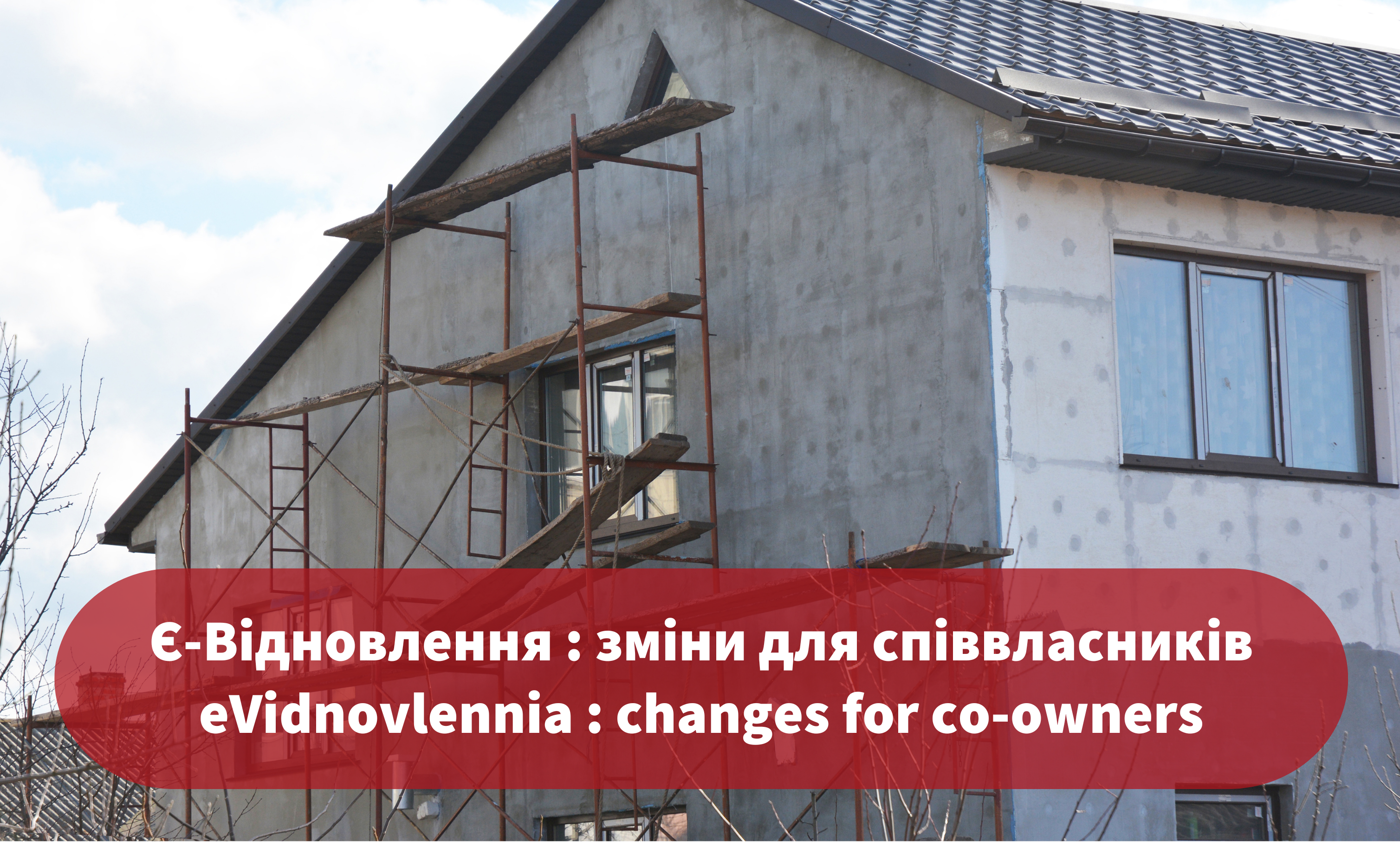
The eVidnovlennia (eRecovery) program remains a key state instrument for supporting people whose housing has been damaged by the war. However, practical implementation revealed that one category of applicants had fallen into a legal grey area - co-owners of a single housing property. It was specifically for this group that the Cabinet of Ministers updated the rules, removing a key obstacle that for years had complicated the submission of applications and the receipt of compensation. The amendments entered into force on 5 January 2026. For clarity, it is important to note that these changes concern compensation for the restoration of damaged housing that can be repaired through current or capital repairs.
What Was the Difficulty?
Previously, compensation could in practice be received by only one co-owner who submitted an application through the Diia application. The procedure was complicated because:
- co-owners did not have a clear instrument to declare their ownership share;
- regulatory acts did not define a mechanism for coordination between co-owners;
- the absence of consent or a clear notification procedure created risks of conflicts and, as a consequence, court disputes.
As a result, some people were unable to proceed further due to uncoordinated ownership shares, lack of communication between co-owners, or the unwillingness of one of them to confirm their share (previously, compensation could be obtained only with the mandatory written consent of all co-owners). The previous version of the Cabinet of Ministers’ resolution did not detail this issue.
What Changed as of 5 January 2026
The updated rules provide that:
- compensation is calculated proportionally to the ownership share, rather than based on the decision of the applicant or agreements between co-owners;
- for joint ownership, shares are considered equal unless otherwise determined by a contract or a court decision;
- submission of an application by one co-owner no longer blocks compensation for others - each co-owner may receive compensation for their own share;
- a clear procedure has been established for notifying co-owners of the intention to submit an application;
- ownership shares are verified exclusively based on data from the State Register of Property Rights to Immovable Property, without additional documents.
How Should a Co-owner Act Now?
The main risk for co-owners is failure to notify, or improper notification of, other co-owners about the intention to submit an application and receive compensation. To avoid problems when applying for compensation, it is recommended to:
1) Check your ownership shares in the State Register of Property Rights to Immovable Property
If the information is missing or outdated, initiate its update by applying to the State Registrar.
2) Notify other co-owners in writing
Proper proof of notification under the updated rules includes:
- the original or a copy certified by the applicant of a delivery notice confirming receipt by the co-owner of a registered postal item or a declared-value postal item;
- the original or a copy certified by the applicant of a registered postal item or declared-value postal item marked as refused by the co-owner;
- notification by other means, for example:
-email correspondence;
-screenshots from messaging applications;
-notification through a notary (when the co-owner is unknown or contact details are unavailable), etc.
3) Submit an application via the Diia application, attaching proof of notification of other co-owners
The updated procedure has become an important step toward fairness and predictability in the process of obtaining compensation for co-owners. It ensures a proportional and objective approach, prevents compensation from being blocked due to the human factor, and contributes to strengthening property rights protection during the country’s recovery period.
If you still have questions or need a consultation, you may book an online consultation with an experienced lawyer.
This information material has been produced as part of a project implemented by the Danish Refugee Council (DRC) with funding from the European Union. The views and opinions expressed are those of the author(s) alone and do not necessarily reflect the views of the European Union or the DRC. Neither the European Commission nor the DRC can be held responsible for the content of this material.