How to obtain a death certificate for a person who died at the site of a shelling but whose biological material has not been found
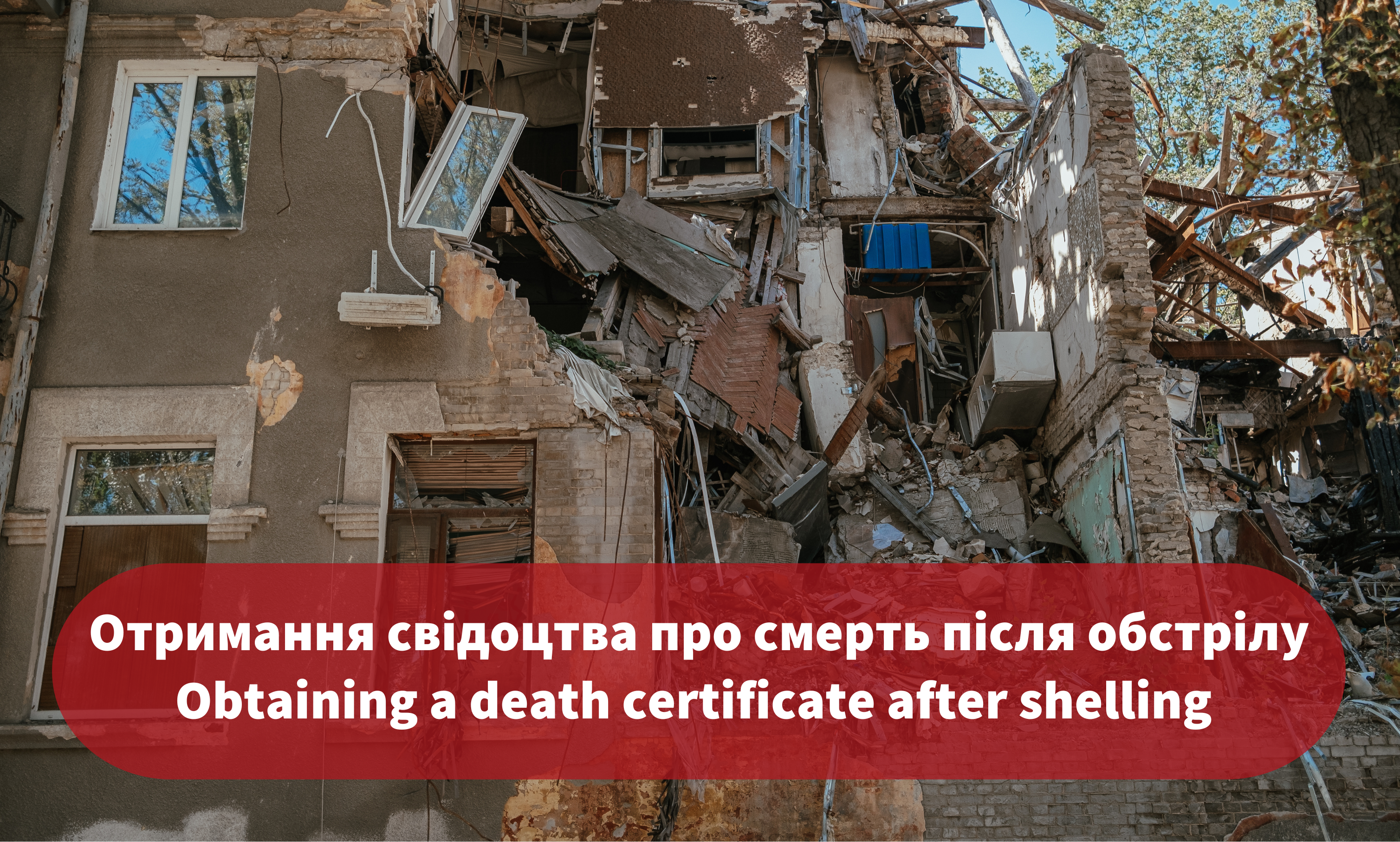
In the context of armed conflict, situations arise where, as a result of missile and artillery shelling or UAV attacks, deceased persons cannot be found or identified. This creates a legal situation in which relatives need to obtain official confirmation of death.
In such cases, the procedure for declaring a person deceased may be applied. A court may declare a person deceased if:
- under the general rule: there is no information about the person’s whereabouts at their place of permanent residence for three years;
- under special circumstances: if a person went missing under circumstances that threatened their life or give grounds to presume death as a result of a specific accident, the court may declare the person deceased after six months;
- during wartime: under circumstances related to hostilities, this period may be reduced to six months from the date of cessation of hostilities.
In cases of death during missile or artillery shelling or a UAV attack, it is the second option that applies — declaring a person deceased six months after the accident.
Declaration of a natural person deceased during martial law in Ukraine
Ukrainian legislation establishes special rules for persons who went missing as a result of hostilities. Under the general approach, if a person went missing during combat operations, the court may declare them deceased two years after the end of such hostilities.
At the same time, the law allows for a shortened timeframe. Where sufficient grounds exist, the court may declare a person deceased earlier, but not earlier than six months.
The time limits are calculated from the date of cessation of hostilities in a specific locality, not from the date of introduction or cancellation of martial law. These are different legal categories and should not be confused.
Does the inclusion of a locality in the list of combat areas matter
To determine the territorial and temporal characteristics of hostilities, courts refer to the List of territories where hostilities are (were) conducted or which are temporarily occupied by the Russian Federation, approved by an order of the Ministry for Reintegration of the Temporarily Occupied Territories of Ukraine.
Importantly, this document also contains information on the start and end dates of hostilities in the relevant territory, which helps the court determine the starting point of the six-month period for declaring a person deceased. When considering the case, the court assesses whether the person was present in such a territory, the circumstances of disappearance, and whether there is evidence of life-threatening conditions.
Applying to court for declaration of a person deceased
An application for declaring a natural person deceased is submitted to the court under separate proceedings:
- at the applicant’s place of residence;
- at the last known place of residence (stay) of the person whose whereabouts are unknown;
- at the location of the property of the person whose whereabouts are unknown.
The application must state:
1)the purpose for which the applicant seeks to have the person declared deceased;
2)the circumstances that threatened the life of the missing person;
3)the circumstances that give grounds to presume death as a result of a specific accident or due to hostilities.
Evidence required to substantiate the court application
The specificity of cases concerning the declaration of a person deceased lies in the fact that, unlike establishing the fact of death, this mechanism applies where no direct evidence of death exists. The court’s conclusion is based on a legal presumption of death, as direct proof is usually unavailable.
The applicant must provide convincing indirect evidence, which taken together allows for a probable conclusion of death.
Such evidence may include:
- witness statements from individuals who observed the circumstances of the disappearance;
- documents confirming search operations;
- expert opinions (if conducted);
- materials from criminal proceedings (if initiated);
- documents confirming refusal by civil registry offices to register the death;
- other documents confirming the circumstances of disappearance (photos, video footage from the presumed place of death, responses from the State Border Guard Service of Ukraine regarding border crossings, SES reports on incidents that could have led to death, information from local military administrations on whether the person appears on evacuation lists).
In such cases, witness testimony from persons who were with the missing individual and documents prepared immediately after the incident (reports, acts, notifications) are of particular importance.
Determining the date of death of a person declared deceased
Under Part 3 of Article 46 of the Civil Code of Ukraine, a person is declared deceased from the date the court decision enters into legal force.
However, if it is possible to establish a specific date or period when the event leading to the presumed death occurred (for example, the date of a missile strike), the court may determine this date as the date of death.
The significance of the date of death for inheritance relations
Determining the date of death is of fundamental importance for inheritance matters, as inheritance opens on that date (Article 1220 of the Civil Code of Ukraine).
If the court establishes the date of probable death rather than the date when the decision enters into force, this may significantly affect the circle of heirs and the composition of inherited property, especially where a considerable period has elapsed between these dates. The date of death also affects entitlement to social benefits, including:
- survivor’s pensions;
- other social benefits and privileges for family members of the deceased.
Often, the need to obtain such payments is the main reason for applying to the court to declare a person deceased.
Steps to obtain a death certificate for a person declared deceased
The sole basis for state registration of death in this case is the court decision declaring the person deceased.
To obtain a death certificate, apply to any civil registry office (DRACS) regardless of the applicant’s or deceased person’s place of residence, and submit an application for issuance of a death certificate.
Attach:
- the court decision declaring the person deceased with a note on its entry into force;
- an identity document;
- documents confirming family ties (if required).
What to do if a person declared deceased reappears
Declaring a person deceased is a court decision based on a presumption of death. If the person reappears or information about their whereabouts becomes known, the court cancels the decision declaring the person deceased (Article 48 of the Civil Code of Ukraine).
Key points to consider when preparing and submitting an application
1)A common mistake is filing an application to establish the fact of death (Clause 8, Part 1, Article 315 of the Civil Procedure Code of Ukraine) instead of an application to declare a person deceased. Where there are only assumptions of death without reliable evidence (e.g., no identified body), the correct approach is to apply for declaration of death.
2)Applicants often fail to provide sufficient evidence confirming circumstances giving rise to a presumption of death.
3)Involving all interested parties is essential, as it helps the court avoid unlawful decisions and prevents competing decisions in the future.
Possible obstacles in court proceedings
Cases concerning declaration of a person deceased should be considered within two months from the opening of proceedings. In practice, however, these time limits may be extended due to difficulties in summoning witnesses, obtaining information from the Ministry of Defence of Ukraine, investigative bodies, local authorities, or due to suspension of court operations.
What to do if the court refuses to satisfy the application
If the court refuses to declare a person deceased, the applicant may:
- appeal the court decision;
- submit a new application if new evidence becomes available;
- apply to establish the fact of death (rather than declaration of death) if reliable evidence emerges (e.g., DNA identification of remains).
Declaring a person deceased in cases of death caused by missile or artillery shelling or air attacks without recovery of the body is a complex but feasible procedure. The key is to collect as much evidence as possible regarding the circumstances of death, seek confirmations from competent authorities, and rely on qualified legal assistance. If you have questions or need advice, you can register for a consultation at this link.
This informational material was created within the framework of a project implemented by Charitable Foundation “Caritas Kharkiv” in cooperation with the Danish Refugee Council (DRC) and funded by the European Union’s Civil Protection and Humanitarian Aid Operations. The views and opinions expressed are those of the author(s) and do not necessarily reflect the views of the European Union or the DRC. Neither the European Commission nor the DRC can be held responsible for the content of this material.