Registering a child's place of residence has become easier for families of prisoners of war and missing persons
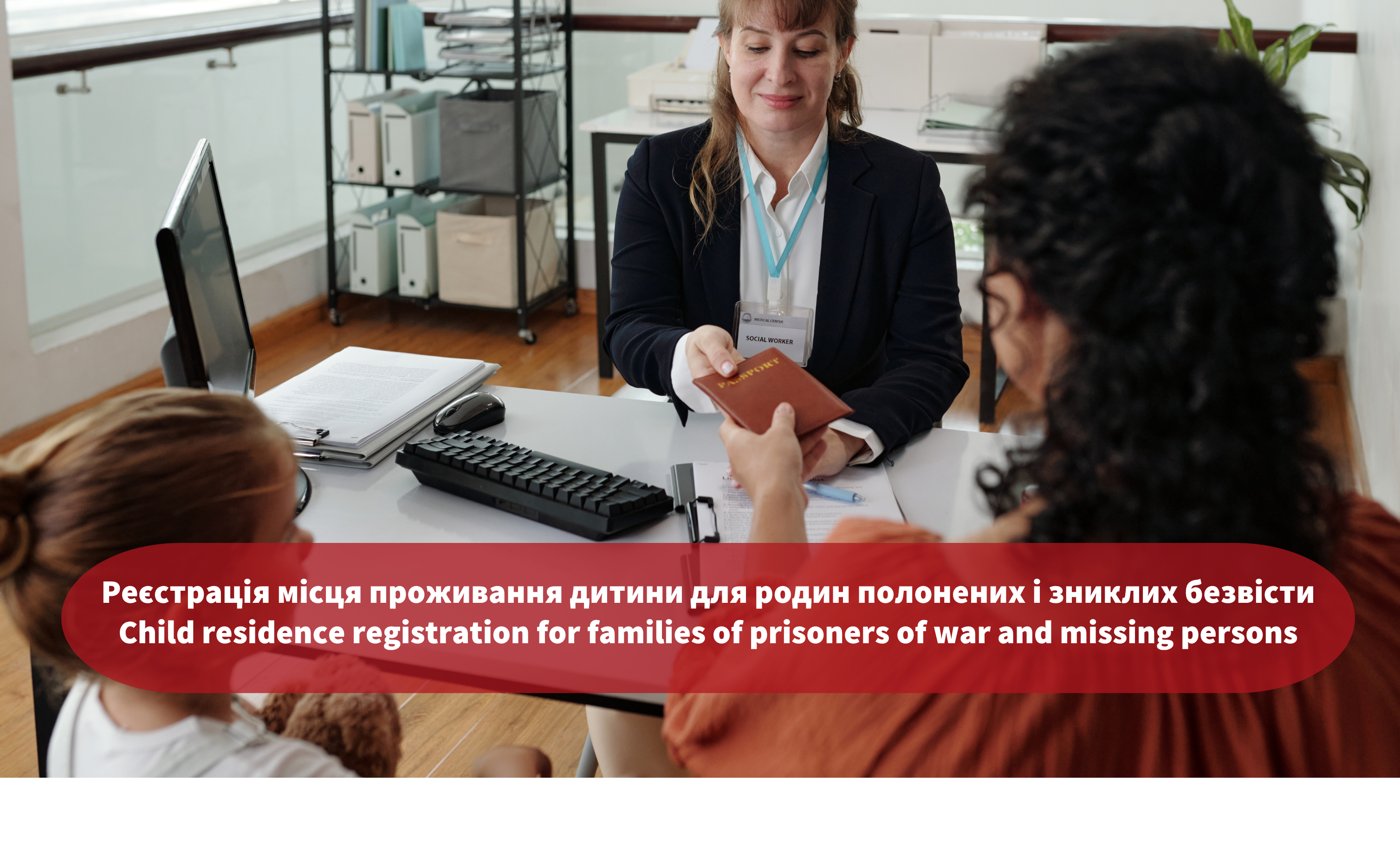
A child's place of residence registration determines access to social benefits, healthcare, education, and administrative services. It also helps confirm the child's connection to the local community. For this reason, any difficulties with this procedure have a particularly significant impact on the families of prisoners of war and persons missing under special circumstances.
On 13 May 2026, the Cabinet of Ministers of Ukraine adopted Resolution № 648, introducing updated rules for place of residence registration. The Resolution also establishes the procedure to be followed when one parent cannot provide consent because they are being held in captivity or have the status of a person missing under special circumstances. The Resolution entered into force on 30 May 2026.
Previous Procedure
Before these amendments, the general rule was quite strict: a child's place of residence could be registered upon the application of one parent or another legal representative only with the consent of the other parent or legal representative. This requirement also followed from the Law of Ukraine "On the Provision of Public (Electronic Public) Services Related to the Declaration and Registration of Place of Residence in Ukraine."
The Diia portal also required the consent of the other parent or legal representative to be included in the application package, except where the child's place of residence had already been determined by a court decision or by a decision of the guardianship and custody authority. Such consent had to be given either in the presence of an authorised official or in a duly certified form.
Practical barriers
In practice, the main difficulty was that the consent of the second parent was formally required, but obtaining it was objectively impossible. As a result, families found themselves in situations where a child's right to proper registration depended on a document that simply could not be provided.
An additional complication arose because the legal status of a person missing under special circumstances does not terminate that person's family status. Ukrainian legislation expressly provides that obtaining such status does not change a person's marital or family status until the marriage is dissolved or the person is declared deceased by a court. Consequently, from a legal perspective, the second parent continued to be the child's legal representative, meaning that the requirement for their consent did not automatically disappear simply because the person had gone missing.
As a result, families were often forced to apply to a court or to the guardianship and custody authorities. This meant additional time and financial costs for families already facing difficult circumstances.
What has changed
Resolution № 648 introduced a special rule applicable during martial law and for six months after its termination or cancellation. From now on, if one parent is being held in captivity or is officially recognised as missing under special circumstances (supported by the relevant documentation), the consent of only one parent or legal representative is sufficient.
This rule applies both to the registration and deregistration of a child's place of residence. At the same time, the child may only be registered at the address of the parent or legal representative submitting the application.
The new Procedure
The procedure is now considerably simpler:
- The application is submitted by one parent or another legal representative;
- The consent of the other parent is not required if there is official confirmation that the parent is being held in captivity or is missing under special circumstances;
- The applicant must provide:
- an extract from the Unified Register of Persons Missing Under Special Circumstances — where the parent is missing;
- a certificate confirming captivity — where the parent is a prisoner of war (issued by the Ministry of Defence of Ukraine or another authorised authority);
- The child's place of residence is registered at the applicant's address;
- The service is available offline through a Centre for Administrative Services (CNAP) or the relevant registration authority.
Registration of a child's place of residence directly affects access to public services and serves as the basis for many other administrative procedures, ranging from obtaining social assistance to enrolling a child in school or registering with a healthcare provider. Removing a requirement that was effectively impossible for many families to fulfil significantly reduces legal barriers for children affected by the consequences of war.
At the same time, applicants should prepare the necessary supporting documents in advance, as these documents now replace the consent of the other parent.