Seeking solutions to improve social protection for victims
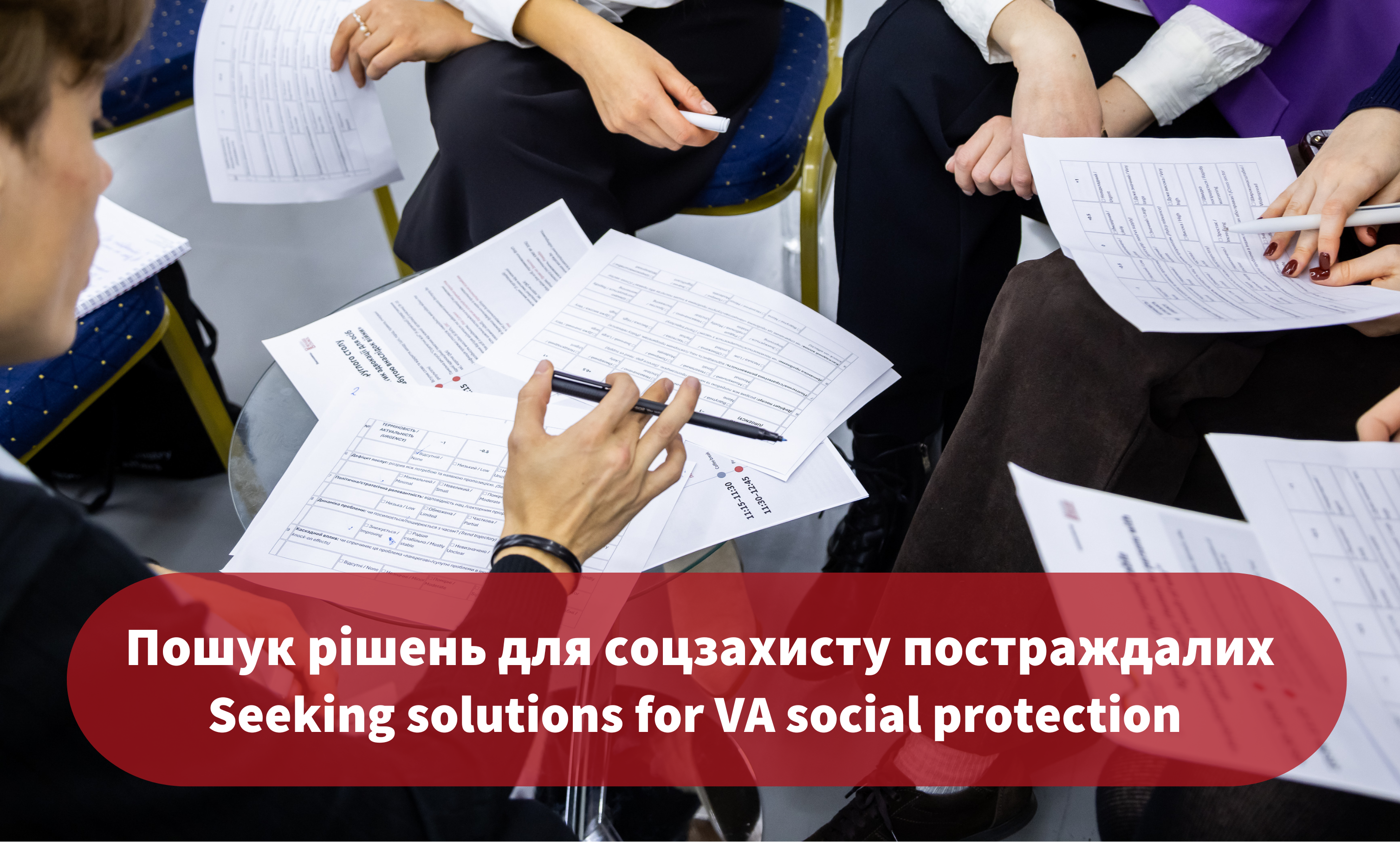
On 17 October 2025, a round table discussion entitled ‘Prioritisation of advocacy themes for persons with disabilities as a result of war’ was held in Kyiv.
The meeting was attended by over 40 representatives of government agencies, international and national humanitarian organisations, associations of persons with disabilities, and relevant experts. The aim was to identify common priorities for improving policies, legislation, and practices for providing assistance.
The event programme included two panel discussions – ‘Strategic Visions’ and ‘Practical Challenges’. Participants presented eight key topics, after which they worked in three subgroups to prioritise them jointly. Based on the results of the subgroups’ work, a list of priority areas for further expert development was agreed upon.

The first panel discussion on ‘Strategic Visions’ addressed issues affecting long-term planning and institutional mechanisms for implementing decisions:
• Comprehensive support for civilians affected by armed conflict.
Focus on coordinating procedures and ‘aid routes’ to eliminate gaps between administrative statuses.
• Access to employment for persons with disabilities.
Consideration of mechanisms to ensure equal access to work and support for employers.
• Harmonisation of building regulations with accessibility principles.
Proposals for adapting state standards to current needs and accessibility standards.
• Involvement of survivors in decision-making processes.
Discussion of models for involving victims in decision-making processes.

The panel discussion ‘Practical Challenges’ focused on legal, procedural, budgetary and interagency issues affecting the implementation of support:
• Recognition of war-related disability for persons injured by EO in temporarily occupied territories.
Analysis of the accessibility of procedures for establishing causality.
• Improving the procedure for granting status and distribution of powers. Proposals for simplifying procedures and defining the functions of responsible institutions.
• Early access to rehabilitation and technical aid. Discussion of opportunities to provide assistance prior to the formal establishment of disability, including the integration of psychosocial support.
• Evaluation of the effectiveness of social protection programmes and budget allocation. Approaches to planning funding based on programme performance evaluation.
During the second panel discussion, a representative of the Office of the Human Rights Ombudsman provided expert comments and clarifications in an open microphone format.

Approach to prioritisation
Subgroups conducted assessments using the Urgency × Feasibility methodology developed by the DRC and adapted for use by the Expert Working Group.
- Urgency refers to the scale of the problem, its impact on different groups, and the consequences of delays in resolving it.
- Feasibility – the possibility of implementation, taking into account legal, budgetary and institutional factors, as well as risks and time frames.
The average scores of the three subgroups formed the overall rating. At the same time, all topics remain in the work of the Expert Working Group.

Involvement of partner organisations and aid recipients
The organisers noted the importance of partner organisations' participation in improving national programmes and policies and encourage feedback on the accessibility and effectiveness of public aid. The information obtained is used to adjust the direction of work and plan further steps.

Notes:
1* The ETF position paper, containing assessment forms, conditions and detailed evaluation results for the three subgroups for each criterion, as well as clear descriptions of the issues and proposed approaches, is available at the following link: [link].
2* The formulation of initiatives may be updated/refined based on the results of further consultations; coordination of the Expert Working Group is open to cooperation at all levels (central, regional and local; with governmental, non-governmental and international partners).
This information material has been produced as part of a project implemented by the Danish Refugee Council (DRC) with financial support from the German Federal Foreign Office. The views and opinions expressed are those of the author(s) alone and do not necessarily reflect the views of the German Federal Foreign Office or the DRC. Neither the German Federal Foreign Office nor the DRC can be held responsible for the content of this material.