Compensation for destroyed housing held in joint ownership
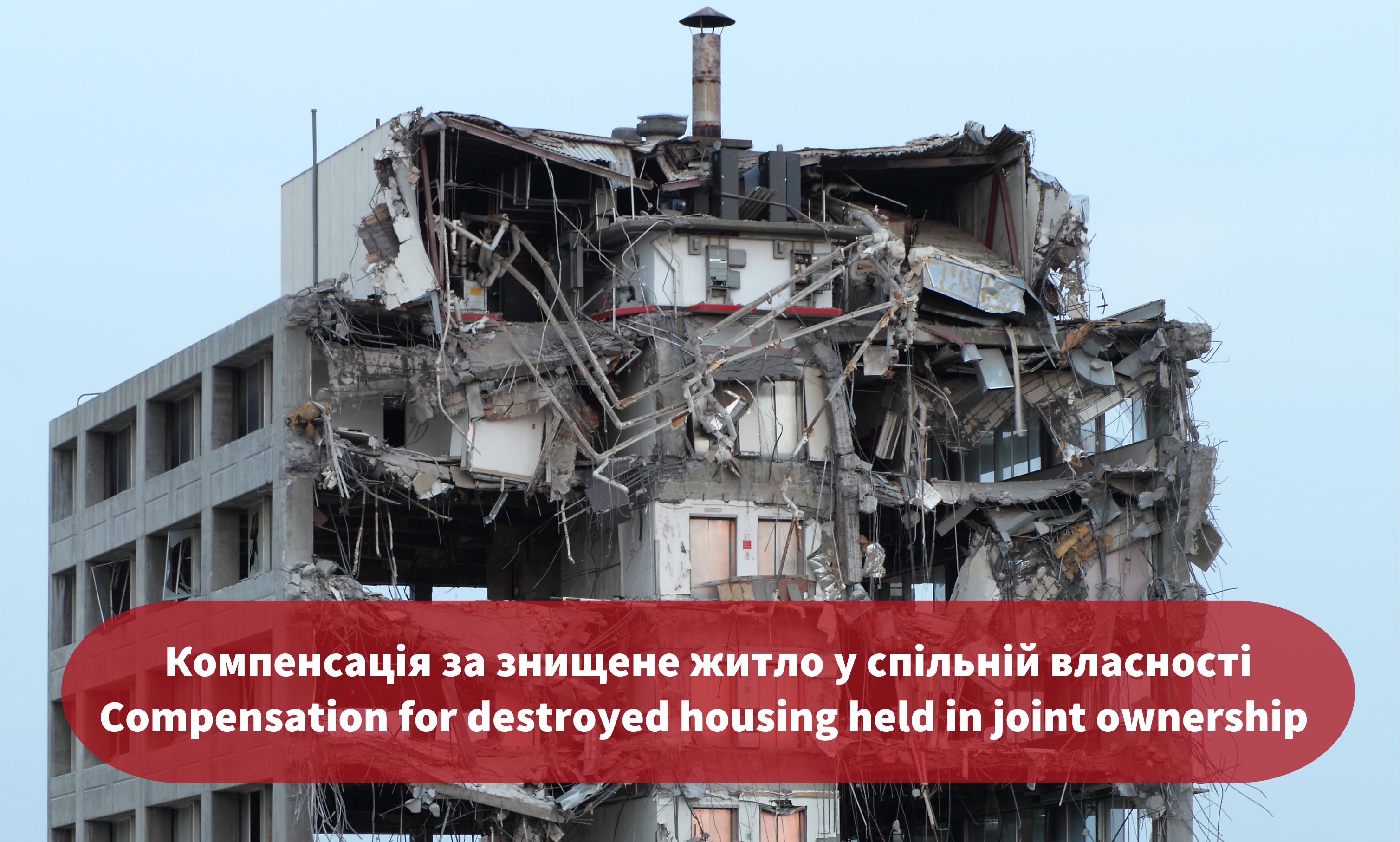
If your home has been destroyed as a result of a military emergency caused by armed aggression, you are entitled to monetary compensation following an official inspection of the property. In this article, we explain who can apply for compensation, how to submit an application, and how to obtain a housing certificate when a property has multiple co-owners.
Joint ownership of immovable property means that several people own the property without defined ownership shares.
Shared ownership means that each co-owner has a defined share (for example, 1/2, 1/3, etc.).
An application for compensation may be submitted either by each co-owner individually or by one co-owner acting on behalf of all co-owners.
Where only one co-owner submits the application, they are deemed to be acting on behalf of all co-owners unless the others object.
If there are objections, they must be submitted through the Register of Damaged and Destroyed Property for consideration by the Commission for Reviewing Compensation Claims.
How to submit an application
An application for compensation may be submitted:
- online through the Diia Unified State Web Portal of Electronic Services;
- in paper form through an Administrative Service Centre (CNAP), a social protection authority, or a notary.
A co-owner who is abroad may choose whichever of these methods is most convenient in their circumstances. However, for a co-owner residing in temporarily occupied territory, both options may be inaccessible.
Common challenges faced by co-owners
Co-owners often face practical and legal challenges, including:
- they may no longer be in contact or live together and may reside abroad or in temporarily occupied territory;
- a share may belong to a deceased relative or to a person whose whereabouts are unknown, making court proceedings necessary;
- one co-owner may refuse to apply for compensation, disagree with the amount of compensation, or raise other objections;
- a share may belong to a child, a legally incapacitated person, or a person with limited legal capacity.
If one of the co-owners is a child under the age of 18, a legally incapacitated person, or a person with limited legal capacity, the compensation application or any objection regarding compensation must be submitted on their behalf by their legal representative (guardian, trustee, or another authorised representative).
To receive compensation, an applicant must apply to the local self-government authority or military administration responsible for the location of the destroyed property.
How to maximise your chances of receiving compensation
- Verify that information about the property is recorded in the State Register of Rights to Immovable Property.
- Determine the form of ownership. This information can be found in the State Register of Rights to Immovable Property or in the property's title documents.
- If the property is jointly owned without defined shares, obtain the consent of the other co-owners or arrange legal representation through a power of attorney.
- If the apartment or house belongs to several people, determine the legal status of each co-owner (adult, child, legally incapacitated person, etc.).
The Commission will review your application and arrange an inspection of the destroyed property.
The amount of compensation is determined in proportion to each co-owner's ownership share. Where the destroyed property is jointly owned without defined shares, all co-owners are considered to hold equal shares.
Receiving the housing certificate
- If the decision is positive, each co-owner will receive an individual eVidnovlennia housing certificate through the Diia application. The certificate is valid for five years. The certificate must be activated in Diia, and the funds must be reserved before signing a property purchase agreement with a notary.
- Each co-owner receives a separate housing certificate.
- The certificate may be used to purchase housing on either the primary or secondary housing market.
- Co-owners may use their certificates separately or combine them to purchase a new jointly owned home.
If you need legal advice or assistance with these issues, you can book an online consultation with a lawyer via this link.
This information material was prepared within a project implemented by the Caritas Mariupol Charitable Foundation in cooperation with the Danish Refugee Council (DRC) and funded by the European Union. The views and opinions expressed are those of the Caritas Mariupol Charitable Foundation alone and do not necessarily reflect the views of the European Union or DRC.